
There was more to Chicago than the Alumni awards last weekend. How could there not be? Chicago is the city of my youth and it has never left my heart.
I first set foot in Chicago in September, 1974, as a freshman at the University. It is my singular good luck that I first saw the University of Chicago, in all its Gothic splendor, and met Katrina on the same day. They are forever melded in my mind. Even though she and I have traveled far from Hyde Park (the University's neighborhood) and the gauche eighteen year olds we were, I never see the campus without thinking of Katrina.
Which is why it was perfect that Katrina was in Hyde Park herself last weekend. As a member of the Alumni Board of Governors, she chaired the awards committee. (Truth be told, I knew months ago that Muriel was receiving the award.) Katrina had duties and obligations on Saturday, and Warren and I had a meeting with Muriel, but Katrina and I nonetheless found time for a meeting, a hug, and a walk across campus talking furiously the whole time.

The campus was beautiful and all three of us commented on that beauty as we walked. It holds memories―memories of Katrina and me dancing and singing our way across the quad ("The minute you walked in the room, I could tell you were a man of distinction, a real big spender. Hey, big spender, spend a little time with me..."), memories of exiting Cobb Hall after a movie into a misty spring night and being overwhelmed by thoughts of Warren (he will know why when he reads this post), memories of walking across the Midway on a silent, cold winter night and seeing the full moon rise up, terrible and large, and hang over the IC tracks at the far end of the Plaisance.
We met up with Katrina's husband, Ed, near Harper Tower, and Warren and I gave Ed and Katrina a ride to their downtown hotel. The talk never ended. It was too fast, I wanted more, and I was thrilled to see Katrina at all. There were more hugs on Michigan Avenue as they got out of the car; Warren, watching the traffic in the rearview mirror, said tersely, "get back in the car now!"
Warren and I spent the night in Oak Park, where a century plus ago a young architect by the name of Frank Lloyd Wright began to turn architecture upside down. As a freshman, I had lived across the street from the Robie House, one of Wright's masterpieces. The predecessor (and to me the handsomer house) is in Oak Park:

So is what is undoubtedly my favorite structure in all of Chicago, if not the world:

It is a ticket booth—an original!—from the 1892 Columbian Exposition. I find it simply incredible that someone has an original ticket booth in their side yard.
Sunday morning before leaving for Ohio we drove back into the city, to meet another friend for breakfast. John is the same age as my son Ben, and is one of "my kids" from when I used to coach Destination Imagination. He now lives and teaches in Chicago and we were meeting at Ann Sather's.
Well, that was the plan. And a good plan it was, too, except for the fact that John got assaulted after parking his car and before entering the restaurant and it was some 30 or 40 minutes before he could rush into the restaurant, disheveled and wild-eyed, announce he had been assaulted and was filing a police report, and run back out.
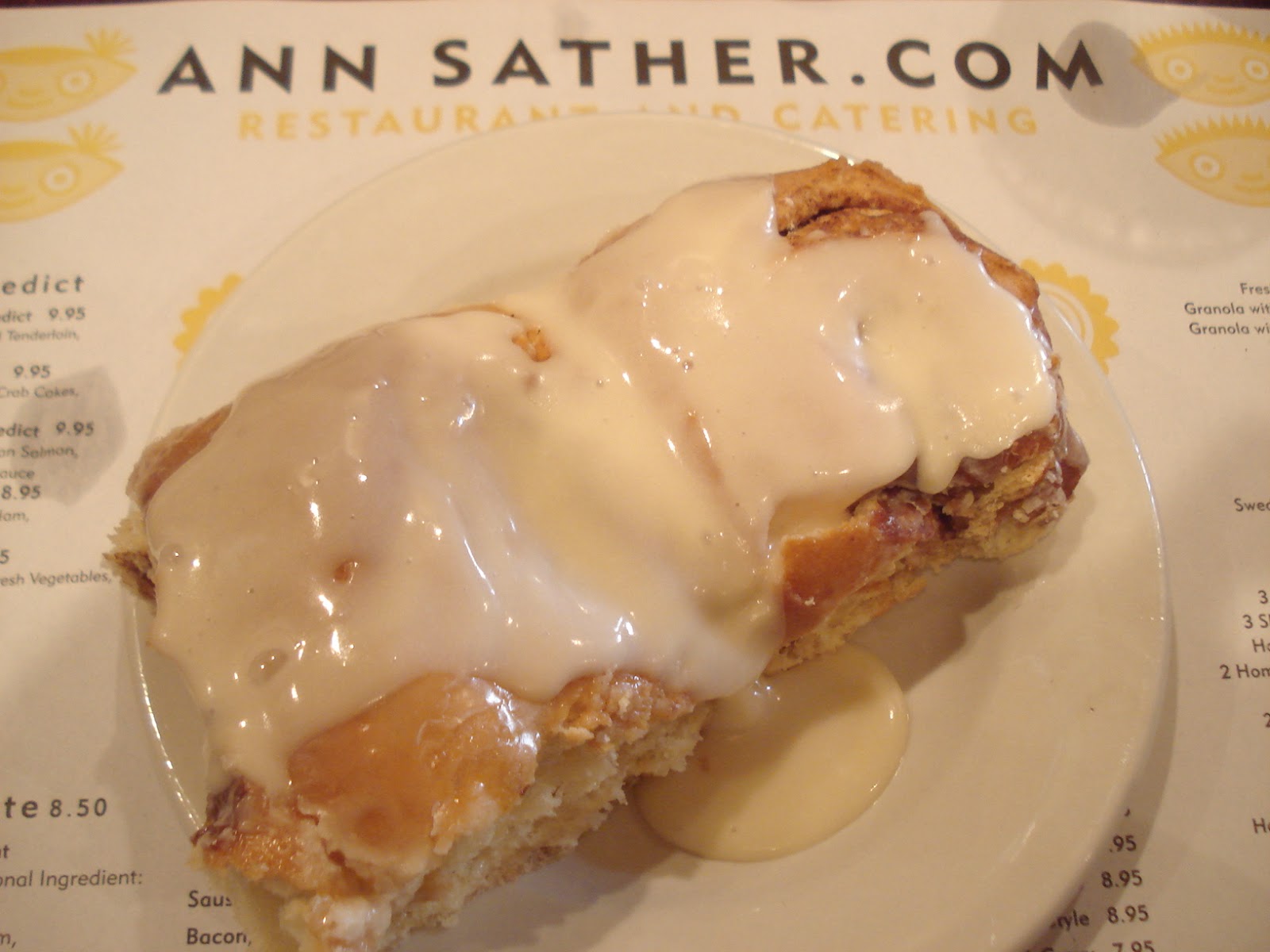
I was so distraught that I had to order a second serving of what are surely the most amazing cinnamon rolls in the world:
 |
| From the blog Lucky Taste Buds! |
The drive from here to Chicago or Chicago to here is a bit under six hours. We took a little longer coming home on Sunday. We meandered deliberately to a small cemetery in a small Indiana town which my great-great-great grandfather helped settle in the 1830s. Henry is buried there and we found his grave fairly quickly.

And we meandered again to drive a portion of the Lincoln Highway, the original US 30.
In recent years, most of US 30 in Ohio has been "improved" into a four-lane freeway and routed around the small towns and cities it once fed. I understand the reasoning behind that: the "new" US 30 is able to carry far more traffic, especially semis, swiftly and more directly than the original roadway. The small towns are no longer congested with diesel fumes and rumbling trucks.
But, oh, what we gave up when that improvement occurred.
We drove the portion of the Lincoln Highway that went into Van Wert, on the western side of Ohio. We came into town through an old residential section, slowing our pace down to match the narrow street. We rolled through a portion of the downtown, much of it shuttered, we drove past the courthouse.
We were driving on what William Least Heat Moon called (and immortalized in a book by the same name) "blue highways." On a blue highway, you will find the local doughnut shop. On a blue highway, you will find the hand lettered sign, "Fresh Eggs," at the edge of a farmhouse. On a blue highway, you will see the small stores and not just the strip malls.
On a blue highway, you will find a piece of this country's, and perhaps your own, past.
My life is threaded with blue highways and they are my preferred routes for travel. Back in my student days, I would sometimes take the Greyhound bus from Chicago to Delaware and back again. The bus in those days only traveled the blue highways. I knew the look and feel of downtown Fort Wayne, of Van Wert, of Delphos and Lima and Kenton.
Driving on the Lincoln Highway decades later, after a weekend in Chicago in my old haunts, I felt the faint touch of the past, light as moth wings, whisper against my face. I raised my hand as if to brush the memories away, drove on through town, and onto US 30.


