Showing posts with label Wizard of Oz. Show all posts

Saturday, June 28, 2025

Baby Steps

Photo by Maxime Horlaville on Unsplash


I am two weeks home from the hospital today, almost three weeks post-hospitalization. My recovery has been...

Slow.

Steady, but slow. 

We all know the phrase "baby steps." We tell it to a friend when they jump into a new project and get overwhelmed at all there is to learn and do.

"Baby steps," we remind them lest they get discouraged. "Take baby steps." 

I am reminding myself that when I get discouraged about my post-hospitalization recovery.

"Baby steps, April. Baby steps."

Yeah, I'm taking baby steps. Mouse baby steps.

We (the medical "we" and Warren and I) are still trying to sort out what happened (a pancreatic bleed of some sort) and, more important, why. (Who knows?) I have an appointment Monday morning with my brilliant surgeon, Dr. Goslin, who followed me through my BIG medical crisis in 2023, who removed my gallbladder in 2024, and who, along with his associates, followed me through this most recent adventure. I am interested to hear his thoughts on what possibly led to the bleed, where he thinks I am now, and what the future might look like. 

I realize that last thread—what the future might look like—may be a lost cause. "Well, that's all. The crystal has gone dark." (Professor Marvel to Dorothy, The Wizard of Oz, 1939.) 

As for me, I am here. Changed (again), but here. The horrific heat dome seems to have broken. (I. Hate. Heat.) I was out at 6:00 a.m. today watering the gardens, listening to the earliest birds of the day. I penned this post at 8:00 a.m., sitting outside on our front porch, watching wisps of clouds scud by overhead. It is mid-morning now as I type and the day is still blissfully cool.

Warren and I have been ending our evenings sitting outside on our front porch in the late evening, after the sun is off the day and the temperatures cooled a little, watching the firefly show in our front yard. It is a wonderful way to pull the day to a close with each other without electronics, without other tasks demanding attention. Just flickering bits of light: on, off, on, on, off.

I am grateful. Grateful for life, grateful for Warren, grateful for those bits of light. 

Wednesday, November 6, 2024

The 2024 Gardens: Part 9

A few weeks ago, while writing about my reentry into canning, I noted that I had taken down our kitchen garden (the Hej garden had gone down a few days earlier) with the threat of a solid frost.  I picked everything that was ripe:

Tomatoes filling our window sill
Or soon to be ripe:

Ripening

But the gardens themselves were down. 

Given the trip to Mayo (which went swimmingly well) and then some health issues with my Dad, I have not yet gotten back to clearing away the tomato vines and other plants that did not fit in the yard waste containers:

The kitchen garden after I tore most of it out

It's autumn. Our days have returned to balmy temperatures. There is a concert coming up (Warren is at the first rehearsal tonight), we have some other things going on, and I knew I would eventually get around to cleaning up the garden.

All in good time, my little pretty, all in good time.

Earlier today, I went outside to dig up some butterfly weed roots for a friend. I had collected a bag of seeds for her, but I knew from our own experience that you can also just transplant the roots and get a stand started that way as well. Scattered between the brick patio and the butterfly weed were...tomatoes. 

When I took down the garden, I picked all the green tomatoes I could, which went into the relish:

Some of the haul from taking the gardens down 

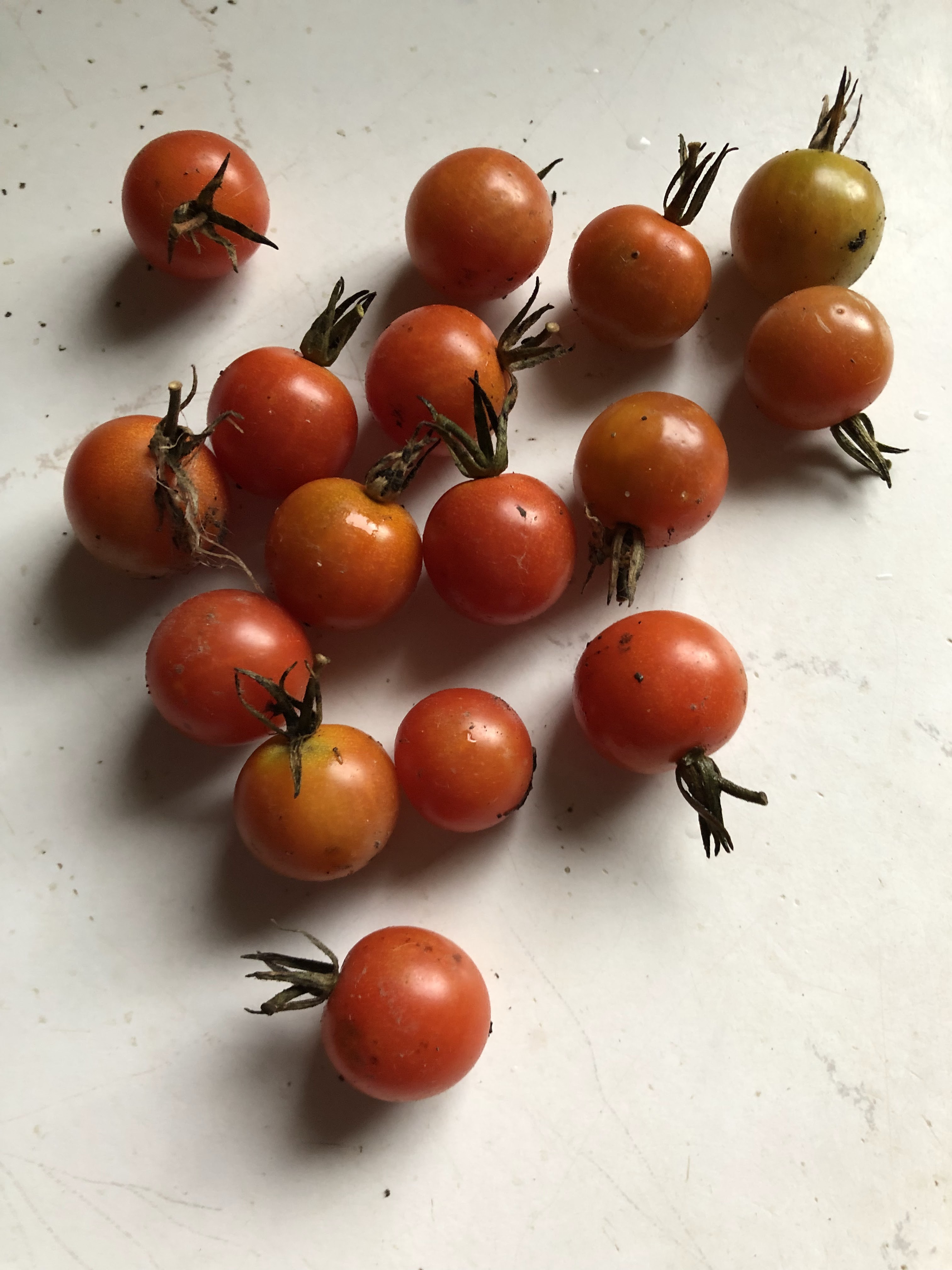
But I did not get every single still green cherry tomato: some fell to the ground, some were hidden in the vines, whatever. And sitting outside these last several days, warmed by the sun, left alone by the squirrels and chipmunks, those green cherry tomatoes ripened.

Ripe tomatoes.

Oh my.

Before we left for the Emerald City on October 27, I had just (just!) finished the very last tomato from this year's gardens. I savored the last bite, knowing darn well it would be June at the earliest before I tasted fresh tomatoes again. 

But here they were: riches at my feet. You bet I carried them inside and washed them:

The very last tomatoes! 

I had a few on my salad this evening. I will have a few more tomorrow and the next day. And then I will say (for a sweet, second time) farewell to the tomatoes for the year. 

Sometimes you find unexpected riches when you are not looking for them. Sometimes, even on the toughest of days, you find treasure.

Today I found treasure. 

Sunday, August 20, 2023

This Year's Gardens: Part 11

 This year's gardens continue. I just this morning started clearing out the Hej garden to replant zucchini in the hopes that maybe, just maybe, we get a crop. I have had a month of more medical appointments than I want (August has contained eight—count 'em! Eight!—counting the two this coming week) and they take a toll on my durability, so I suspect it will next weekend before the Hej is cleared, tilled again, and planted. That task aside, I continue to eat tomatoes (Oh, joy! Rapture!) and think about doing yet another batch of pesto with the late August basil. 

This weekend, however, I was reminded again (always) of how gardens never fail to delight and amuse. This year's gardens are no exception.

Delight #1: Any other summer, the lettuce is usually burnt out by mid-July due to heat and sun. Oh, there are a few straggly bits here and there, and sometimes a volunteer or two will pop up in the fall once things cool down, but lettuce is NOT a summer crop around here.

Until this year. The lettuce beds are going strong and we are in the third week of August. We have been picking and eating the Black Seeded Simpson since early July (maybe late June) and now are adding the Butter Crunch to the salad bowl as well. Fresh-picked lettuce is so delicious that I told Warren I am not sure I can return to eating store-bought lettuce when the season is over. I have not bought tomatoes from a grocery store for years because of the qualitative difference; I wonder if lettuce will be the same. 

I remind myself that back in my youth, lettuce out of season was something you did not see in our local grocery stores. Can we go without lettuce-based salads for several months? Hmmn.

Delight #2: Still in the lettuce bed, but this is a totally unexpected joy. Because the lettuce burns out so early, I have never seen it go to seed. Ever. I could not even visualize a lettuce plant going to seed. 

Until this year. The Black Seeded Simpson has been so hearty and so prolific that it has started to flower. I nipped off a number of the flowering heads to prolong the lettuce, but some I am letting go to full flower. 

A flowering lettuce plant is a thing of beauty and a joy forever. 


Look how delicate those flowers are.


I did not note in my gardening book anything more than the names and locations of the lettuce beds in my garden, but from what I can find online from checking a number of seed companies, Black Seeded Simpson is a heritage lettuce, which means they will grow from saved seed. I am tempted to harvest some of the seeds and hold them for next year.

Amusement of the summer (as in "the joke is on me"): the Cherokee Trail of Tears black pole beans. Not the product; these beans are prolific! No, it is my ignorance in realizing how these beans (and maybe all pole beans) take care of themselves when it comes to drying. I went out to pick more of them today and realized about three bean pods into the harvest that they have been drying themselves. All I need to do was pick them and pop the pods open. Out roll those beautiful beans. 

"Why have you been working so hard, April? We know what we are doing."

My beans picked last week were fine; I dried them for soup when the weather changes. Today's beans will join those, but right now today's beans are laughing at me, saying "Duh, April. You don't know beans about beans." 

As this realization hit me (the work being done by the sun and the beans themselves), I thought back to my past experiences with beans. There were always beans in my grandparents' garden; Grandma Nelson canned green beans by the quart. My parents also grew beans and Mom canned as well. Heck, even I grew and canned beans. But they were bush beans, always something in what I will call the "green bean" family, and you ate them fresh or canned them, period. I have no memories, even stories passed down, of anyone growing pole beans (which can also be eaten fresh). I do not remember seeing poles or structures for them in any of the gardens. I certainly do not have any memories of anyone (and this would have been on my dad's side of the family, as they were the ones whose gardens I knew growing up) drying beans. 

But now I know. 

A phrase several of my medical providers have been using lately is "knowledge is power, " referring to some of the testing I have been going through. I am going to steal that phrase and apply it to my beans: Knowledge IS power, and the power here is not working so darn hard for the same outcome! 


Today's haul 

Thursday, July 26, 2018

Of Books And Bees

We are just back from a quarterly trip to Mayo Clinic in Rochester, Minnesota. I always liken it to going to the Emerald City in The Wizard of Oz. The trip to the Emerald City was a pilgrimage for Dorothy and company, and the trip to Rochester is always a pilgrimage for me.

Pilgrimages are hard. They change you in fundamental ways. What Dorothy found in her sojourn in Oz was strengths within herself that she never knew existed. What I find from my pilgrimages to Mayo are new ways to hold my remaining days in my hands and examine what time means.

And I find books.

Rochester is a town of Little Free Libraries. There are several within easy walking distance of the hotel we always stay at (right on the edge of the main Mayo campus, our favorite, the 5th Avenue Inn and Suites, is a little worn but clean and priced just right). I have never mapped out the library locations, but I know that if I set out from the hotel and stroll the closest neighborhoods, I will come across some.

And I did:


(The bottom one is the saddest LFL in the world. It had only a few worn children's books in it, all slid over on their sides.)

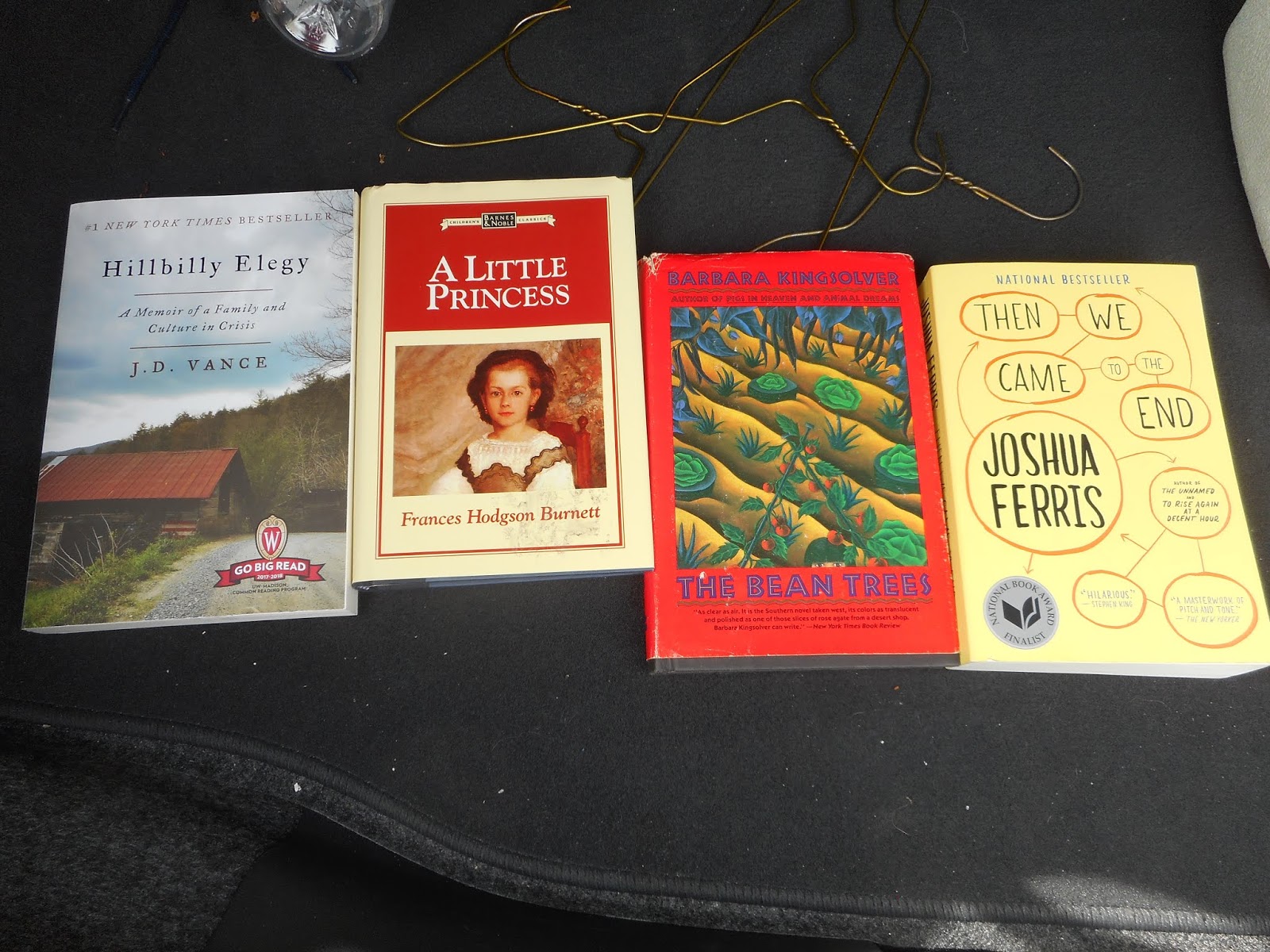
Between the Rochester LFLs and the one we inspected while in on a walk in Madison (visiting family for two days before heading to Rochester) and my dear sister-in-law Margaret gifting me a copy of Hillbilly Elegy that she had picked up for free at the UW Madison library, my trip was rich in books:


And in bees.

One of the many things I love about Rochester is its neighborhoods and the ones on my walking route this time were abloom in every imaginable way: front gardens, side gardens, hanging baskets, more window planters than I have seen since my childhood, and terraced retaining walls. Bees were everywhere, including this one in (what else?) the bee balm:


My absolute favorite planting, however, one I hope to recreate in a space in my own, was this:


No bees in it when I was there, but Queen Anne's Lace and milkweed? Absolutely perfect.

When we drive to Rochester, we turn on US52 from I-90 and come into the city from the south. There is a moment, as you take the Rochester exit and turns towards the city, when you can see the core downtown, including the shining towers of Mayo Clinic, off at a distance, floating on the horizon. When Warren turned on that exit this trip, I looked north, saw the city, and said, softly, "Emerald City."

Wizards, quests, bees, and books. If that isn't Oz, I don't know what is.

Wednesday, August 17, 2016

Inch One Hundred Thirty-One: Update

We are back from vacation, having arrived home Saturday in the early evening.

Sunday was spent in a whirl of laundry, cleaning, unpacking, recycling, sorting, shop work, gardening, and all the other tasks that accompany a homecoming after a lengthy absence. Monday we both jumped back into work: Warren with drumming and a benefit concert at the end of this week, me with the first session of a new court program that my good friend and coworker Cecelia created earlier this year.

Legal Clinic was last night. Clinic was packed with clients and I did not get home until later than I had anticipated (and I ended up leaving before we were all done). We were to have dinner guests tonight, but they had to cancel due to family matters. I regret the loss of the social time, but can make use of the resulting free time. My dear friend Katrina arrives tomorrow for a long weekend; her room is ready.

Chemo resumed yesterday. We (the doctors and I) are trying to get my new treatment regimen (new meds on top of old meds) smoothed out. The vacation, be it the high altitudes or the wear and tear of travel, impacted some of that process in less than wonderful ways and I spent a lot of time on the phone with my personal physician.

It has been raining raining raining here. We have been in and out of rain since Thursday evening of last week. The tomatoes started ripening while we were gone, so we came home to a flood of red. I picked them in some of that rain.

And those are just the headlines, folks.

I will not even begin to write about the vacation until next week. The minimalist packing (room for improvement there), the budget (we did run over the $1000 goal but came in under the $1500 limit), the sights, the impressions: all of that has to wait until later. 

Judy Garland clicked her ruby slippers three times and said "there's no place like home." I know just how she felt.


Thursday, August 4, 2016

Inch One Hundred Twenty-Nine: End of an Era

The Buick is dead.

The Buick is undeniably and reliably dead.

The Buick is not only merely dead, but really most sincerely dead.

Several weeks ago, after months of a brake warning light being on, the brake lines, which were original (1997), finally gave up the ghost. Yes, I was driving at the time. I was able to coast into and through an intersection, then turn up a small street and come to a safe rolling stop. Warren and I waited for the tow truck, then followed the Buick to my mechanic's shop.

My mechanic is swamped this summer, so it took another three weeks before he and his crew could get the Buick up in the air and look at it. I had already been forewarned by the office staff that I was looking at a major bill.

With 19 years on the car, major terminal rust throughout the body, and a whole host of problems just waiting to bloom, "major bill" meant to me "get ready to give it up."

At the beginning of the fourth week, my mechanic called. Dave and I have done business together for many years, and I appreciate that he wanted to break the news to me gently.

The news was bad. Without even getting into the brake calipers, I was looking at $1200. The underbody rust was so bad that the mechanics had a hard time getting the car hoisted in the air as rusted areas kept giving way.

Then Dave delivered the ultimate words.

"April, I can't advise you put that kind of money into this car. Use the money to get another one."

It was like agreeing to turn off life support. I did so. Dave then put a salvage company in touch with me and we made arrangements to have the remains removed.

Warren and I went out the next evening to clear out the car and remove the license plates. I took photos of the rear bumper, which sported bumper stickers of several kinds:


The BUC-EE'S sticker is from my friend Katrina, who used to live in Texas. We visited the Tennessee Parthenon last fall:


Then there is my favorite presidential sticker ever, right next to the just-went-on-the-bumper Tillamook Cheese sticker from my trip to Oregon this September:


Most of them cannot be replaced. I will miss them all.

For now, we are a one car family, although what with my chemo schedule and Warren's Symphony schedule, we often end up borrowing my dad's truck for a day or two. My office is only a four block walk. Other friends have made generous offers of their vehicles.

I live in a great community.

We are postponing looking for a new car until after mid-August. I will be looking for another older car, albeit now "older" means 21st century. The car may possibly come from the Goodwill auctions in Columbus as I just need reliable wheels. I do not need a car payment, so there will be no new shiny Prius in my future.

It is inconvenient being a one car (and a loaner as needed) family, but this is truly an inconvenience of first-world magnitude. Even within this community, it is a privileged inconvenience at that. Working at the Court and at the Legal Clinic, I know lots of us out there scrape by with no car or no reliable car, which is only marginally better than no car at all. And I know that my inconvenience will be relatively short-lived.

Alas, poor Buick, I knew it well.


Friday, May 13, 2016

Inch One Hundred Seventeen: Windings

I have the day off and have spent the morning running some errands and doing some chores. I needed to stop at my Aunt Ginger's apartment, a block away, to get her signature on various documents for an upcoming medical appointment. While there, I asked her if she wanted to come out with me while I went to the bank, and then take a drive.

Ginger jumped at the chance. As she ages, her world becomes smaller and smaller. A car ride is a great opportunity to see some sights.

After a stop at the drive-through bank, I told her we were heading to the East Side, the side of town where we both grew up, the side of town where Ginger lived more than half her life. She would like that. So I headed across the river, turned on Milo, and turned up Flax Street.

The house—the one her father built, the one she lived in for almost 50 years, the one I grew up in—still stands. It has been clad in vinyl siding, replacing the old, soft white asbestos shingles that used to cover it. I had to point it out to Ginger: between her fading memory and the different appearance of the house, she wasn't sure which one it was. We turned up Carlisle to Delta, passing the house that Mrs. Willis lived in throughout both our childhoods, turning past the house that was always Aunt Jane's house and, before that, my great-grandfather's house. She commented on all the new houses in what used to be large lots; Habitat For Humanity has transformed the neighborhood. We drove past the old junkyard, long decommissioned and now empty. We turned back down Flax and I commented that whoever owned the Flax Street House had fenced off a small part of the backyard and let the rest to the north go to trees and brush. It gives the backyard a wild, enticing air.

I then drove Ginger out of town, first to the cemetery where her parents and her paternal grandparents are buried. Three of her infant brothers are out there, as well as Uncle Arthur, who died in combat in World War I. We walked slowly back to the graves, Ginger holding firmly onto my arm. From there we went to the Kilbourne cemetery where my brother, my dad's parents, and my infant sister are buried, and where my parents and Aunt Ginger will eventually be. Then we turned and headed back to Delaware.

At 86 and several months, Ginger is unsteady on her feet. Her body is slowly winding down: the bones ache, the arthritis flares, the gait is shaky and uncertain. She always takes an arm when it is offered.

Her mind has been winding down for the last few years as well. There are more and more gaps in her short-term memory, and I have taken over most of her responsibilities for appointments and financial matters. She may ask the same question several times; today's question was whether she had a headstone yet. But Ginger's sense of humor is intact, and her memories of long ago, even though repeated more than once in a conversation, are still strong. Today the talk was of an adult neighbor up Flax Street who had dirty feet (Ginger knew this because the woman went barefoot and often propped her feet up on the porch rail) and the proprietor at the little corner store who ran a numbers racket on the side back in the 1930s. We shared memories of Aunt Jane, her older sister, and laughed together.

At 60, I am aware of my own winding down. Some of it is just being reflective of my age, as in both "I never though I would make 60" and "so this is what 60 is like." More of it is my awareness that the myeloma is wearing me down. In my most recent Myeloma Beacon column, to run later this month,  I compare myself to Tik-Tok of Oz, Baum's mechanical man who was tireless as long as he was wound tight, but who came to an abrupt halt when he wound down.

At this stage of the myeloma, I too am starting to wind down.

We had a beautiful morning, my aunt and I. We laughed, we talked, we wound our way around the county from town to rural cemetery to rural cemetery and back again. By the time I walked Ginger into her apartment, she was glad to be home so she could rest. She is winding down. By the time I drove the block to our house pulled in, I was glad to be home as well and for much the same reason.

I am discouraged somewhat by my winding down, but not surprised and, so far at least, not overwhelmed by it. For some months, I have been coming to the realization that I am having to learn how to say goodbye to the world. Even so, there are still those moments, so many moments, of incredible joy and delight and wonder. I would say even at the lowest points, joy and delight and wonder still light my path.

One of today's joys was being out with Aunt Ginger, just two aging women who are winding down, winding through the county and through our memories.


Thursday, December 31, 2015

Inch Ninety-Eight: 2015 By The Numbers

As we all prepare to wrap up the year, I have whiled away the hours thinking of things I could count for 2015. It turned out to be a fun exercise.

This is what 2015 looked like for me:

Number of blood draws/IV sticks (successful or not): 30 (probably low)

Number of times my new port has already been used to great personal acclaim: 4

Number of trips to Portland, Oregon: 2

Number of trips to Rochester, Minnesota: 2

Number of times I walked through the grounds of the Alamo: 3

Number of states I was in or drove through, not counting Ohio and not counting flyovers: 12 (I had originally posted 11, but Warren reminded me of Iowa)

Number of days old Ben was as of December 16, when he turned 30: 10,958

Number of  days old Sam was of as June 28 when he turned 25: 9132 

Number of days old Ramona will be as of today, December 31: 1217

Number of presidential debates watched this year, either party: 0

Number of bowls of oatmeal eaten for breakfast: 260 (more or less)

Number of batches of biscotti baked for the holidays: 10

Number of pieces of biscotti 10 batches make: Over 800

Number of batches of peanut brittle Warren made for the holidays with his son's help: 3 (plus 1 burned batch)

Number of Preservation Parks out of 9 we have walked in: 3

Number of concerts Warren played in this year (not counting rehearsals): 16

Number of concerts Warren played in that I attended: 13

Number of church services Warren played: 5

Number of church services Warren played that I attended:  4

Number of books I read: Ha! You think I keep track of that?

Number of Legal Clinics held: 12

Number of Legal Clinics at which I volunteered: 11

Number of clients served for the year: 228 (not counting the phone consultations) 

Number of poems written into final draft: 59

Number of poems written still in rough draft: 8

Number of 1000 piece jigsaw puzzles completed: 2

Number of hugs given and received: too many to count

Monday, September 7, 2015

Inch Eighty-One: The 500th Post

This is my 500th post since starting this blog in 2009. At the rate I am now writing (approximately one post a week), it would take me almost ten years to double that number.

I'll be blunt. The likelihood of me having ten years left are slim to none given the cancer. Mostly none. So unless I speed up my rate of writing (also an unlikely prospect), chances are I will never hit that elusive 1000 mark.

But 500 is nothing to sneeze at. It's a nice solid number, a nice benchmark.

Faced with the prospect of the 500th post, I am not sure I have much to say. I am writing this out, as I usually do, by longhand. It is Friday night of Labor Day weekend. Thanks to the miracle of scheduling publication, I will upload and set this post to run sometime next week (probably Monday), as well as set my 501st post to run the following week.

I don't usually frontload posts to run, especially two weeks out, but I have good reason to rely on that crutch right now. Come Tuesday in the wee hours of the morning, Warren will drop me off at the airport so I can catch a plane to Portland. I am heading out to see Alise, Ben, Sam, old friends, and other dear family members, but most especially I am headed out to see this young lady:


Ramona just turned three on September 1. She loves books and imaginative play and "The Wizard of Oz"(the real deal), going so far to ask me if I liked "the windy part" (the tornado). I cannot wait to join the enchanted circle of her life. Faced with so much richness, I do not want to be tethered to a computer while I am away.

Rosh Hashanah begins while I will be out there, and I plan to usher in the New Year with a meal for the people I love. I will be baking pies, and I will help Ramona bake her very first pies in small tins.

After all, she is three now. It is high time.

I can't wait.

Saturday, June 13, 2015

Inch Sixty-Seven: What the Tower Held


When I posted last week, Warren and I were in Rochester, Minnesota, while I underwent a consult at the Mayo Clinic. I had just arranged a tour of the Mayo carillon. I wrote:

Mayo is unique in that it has its own carillon atop the Plummer Building, a 1926 structure with fantastic terra cotta ornamentation. For the unaware, a carillon is a musical instrument (percussion, of course) that has at least 23 tuned bronze bells. It is played by a clavier (keyboard) and clappers, not by swinging like the typical church bell.) While the building was being constructed, William Mayo (one of the two Mayo brothers) went to Belgium and become enraptured of carillons. When he returned to Rochester, he had the architect revise the building plans and add a carillon tower on top. Until 2001, the Plummer Building with its carillon tower was the tallest structure in Rochester. The carillon currently has 56 bells in it.

I have always, always wanted to be up inside a carillon tower. Rockefeller Chapel at the University of Chicago has one, but I have never managed a tour. The Mayo allows tours of its carillon. Needless to say, I was thrilled.


To arrange one, you call the carillonneur (the bell master) directly on his cell phone. What a great small town touch! Jeff was delighted to arrange a tour; he will be playing Thursday morning at 8:30 for the downtown market, and we are meeting at 8:20 in the lobby of the Plummer to climb up into the tower with him. I can't wait.


The carillon tour did not disappoint.

Warren and I arrived early and took a seat in the ornate lobby of the Plummer Building. We had not yet met Jeff, but I was confident we'd know him right away. Sure enough,  a tall, thin man rushed in, broke into a grin, and headed straight towards us. We made some quick introductions and headed up.

To reach the carillon tower, you take the elevator as far up as it will go, then start climbing a tight spiral staircase, identical to ones in lighthouses. As we labored up the spiral stairs, Jeff, who talks rapidly and has a nervous laugh, asked us where we were from.

"Delaware, Ohio," I said and started to add that Delaware was in central Ohio when Jeff broke in and said he knew exactly where it was because he attended his first two years of college at Ohio Wesleyan, our local college. Well! That lead to an exchange between Jeff and Warren of who they knew in common and although Jeff has about a decade of age on me, Warren knew many of the music faculty from the years Jeff attended OWU.

When you get to the top of the spiral staircases, you are in a large room with a work area, a desk areas, and a thing—a generator, perhaps?—that plays the bells on the hours (and, when it is working properly, the quarter hours). Jeff grabbed his organ shoes and we climbed up one final short flight of steps to the top of the world.

A carillon is played by the carillonneur in two ways. The carillonneur plays the pedal board with his feet (think of an organ) and large oak keys called batons with his hands. Playing the batons requires striking them forcefully, not tapping gently. In fact, as I watched Jeff play, I realized that but for my total inability to ever play a keyboard instrument, I would love to play a carillon because you essentially beat on the instrument to get it to sound.


I do mean "beat." Jeff told us that he had taken a long layoff from the carillon while it underwent structural repairs. During that time, his playing calluses softened. When he was once again sat down and started playing, he felt something on the batons. He looked down. There was blood on the batons from his hands breaking open.

Jeff had a 25 minute performance that morning, and we had the run of the carillon tower and the ramparts all around the tower while he played. Here is the view of the rampart and the parapet wall, which wrapped all around the tower.


Except for the lack of Winkies and a bucket of water, I immediately was reminded of Oz and the Wicked Witch's castle. 

Jeff played a wide selection, including "Puttin' on the Ritz." You have not lived until you are high in the sky on the outside of a carillon tower while the carillonneur plays "Puttin' on the Ritz."  (Pay no attention to the man behind the curtain: this is not a quality video!):


Of course, what that brought to mind was this:


It was a wild and wonderful time up in the carillon tower. 

Meeting Jeff and spending time hanging out with him in the carillon tower was treat enough for the day. But as it turned out, there was a bonus for me. I've created a character, Cecil Deavers,  in my nascent youth novel.  Mr. Deavers is tall and thin and animated and moves and talks quickly. In exclamation points, for that matter. It is not at all unusual for the writer to create a character based on real people, but I certainly was not expecting to meet one of my characters alive and playing the carillon in Rochester. I did not tell Warren until later, but I found myself watching Jeff extremely closely, storing up impressions of his movements and his personality. 

What did the tower hold? A stunning carillon, a bell master who knew our hometown, and one of my book characters. You can't make up results like that! 

Friday, October 3, 2014

Inch Thirty-Two: Scraps

It is Friday midday as I sit down to type this. We have a weather front moving through: warm temps, intermittent winds and rain. I walked downtown midmorning to meet a good friend for coffee. I had my umbrella, which I used most of the way coming and going. As I walked along, I marveled at the tree, the green leaves giving way to the reds and the oranges, the leaves in the heights coming down to the ground.

I started this post last evening. I was couchbound, worn to the nub after a long day, a full week, too many late nights the prior weekend, and just a lot packed into too few days. I was recharging—reading and writing—while waiting for Warren, who has had an even fuller week, to come home. Earlier I had taken a walk, an act that is often recharges me, but last night it only wrung out the last dregs of energy within me. Sitting with a pen and an open notebook was perfect.

I have been turning this post over in my mind since last weekend. It has been coming to me in scraps: scraps of ideas, scraps of observations, scraps of memories. As I have tried to give more form to it, I realize I still have just a handful of scraps.

These are just scraps, but scraps can be useful things. Out of scraps you can make a simple meal or patch a rip in a pair of jeans. You can write a reminder note on a scrap of paper. Warren uses scraps in his workshop all the time, to shim a joint, to secure a wobble.

My scraps look like this:

  • Sitting through Rosh Hashanah services last weekend and remembering (I had forgotten) that the melody to the blessing upon opening the ark (where the Torah scrolls are kept) was one I used to croon to Ben as an infant (substituting my own words) to get him to sleep.
  • Finishing the Penelope Niven biography of Carl Sandburg and crying at his death. Good god, the man died in 1967 and I knew that, but it still caught me in the pit of my stomach. 
  • Crying again Thursday morning at the end of The Fall of Hyperion, the sequel to our most recent book club choice. (This book was not one of our choices; I just had to read it.)
  • Hearing the Mansfield pops concert last Saturday, playing and singing various Broadway tunes, and the strong memory of the year Ben's high school performed Les Miserablés when the performers sang "One Day More."
  • A dust devil catching us as we drove the Mansfield that same day, this one spattering chopped straw against our car before it skipped on across the road. The whirling straw reminded me of (what else?) Oz.
  • Baum's Patchwork Girl was called Scraps. His granddaughter, Ozma (yes, they named her that) would duck her famous identity when growing up by asking her friends to call her Scraps. 
  • Seeing the fields take on their bare winter coats as farmers bring down their crops. 
  • Missing my sons and Alise and Ramona and looking up airfares and wondering where we (or at least I)  could shoehorn in a trip yet this year.
  • Missing my sons and Alise and Ramona and looking up airfares and wondering whether I would have enough energy for such a trip if I took it by myself.
  • A supper with our closest friends two weekends ago where we say out on our deck until late, the table and deck lit with candles that we carried out in bunches, eating Margo's good cheesecake and talking, none of wanting to break the spell of the flickering flames by moving inside or turning on harsh lights. 
  • The blanket flowers finally blooming, daring the nights to turn cold, lifting their yellow and red faces to the sun each day.
  • Banned Book Week last week and realizing the first banned book I ever read was The Wonderful Wizard of Oz. 
  • Reflecting that the blue umbrella I carried today was a long ago Mother's Day gift from Ben and Sam, and how I think of them whenever I pull it out.

Scraps.

As I walked downtown this morning, I looked up the street and saw a large gray door, snug between two telephone poles. It was on the tree lawn, and from a half block away it looked to be ten or twelve feet tall. At one level, I knew it wasn't really a door, but my eyes and imagination saw it as such. As I drew closer, the door resolved into a gray tree trunk, framed visually between the two poles several yards apart. No mysterious door after all.

But what a delicious thought for a minute or two. A gigantic door, appearing without notice on a path I have taken a thousand times, beckoning me to open it. Our current read in our Not Quite The End of Your Life Book Club is Was, a novel interwoven with the Oz of both the original Baum book and the 1939 MGM movie. I have written before about the magic of opening a door, starting with my very first post. I have written often about Oz, whether the movie or the book.

Oz and opening doors.

They are scraps I carry with me always.

Friday, September 19, 2014

Inch Thirty: My Facepalm Moment

I was recently invited to join a very small, very exclusive book club, an invitation I accepted with alacrity and gratitude. I don't know what the other two members call it, but I am calling it the Not Quite the End of Your Life Book Club, with a nod of the head to Will Schwalbe and his beautiful memoir of a similar name.

I'll write about the book club soon. This post is about my facepalm moment (yes, facepalm is usually written as one word) when I finished the most recent selection.

The book was Hyperion, the first of a four or five book series by Dan Simmons. Hyperion is science fiction work, a genre I almost never read. This one is cleverly crafted, with a framework based on The Canterbury Tales and with the poetry and persona of John Keats woven throughout.

It was the last two pages, however, that caused me to realize just how clueless I have been for the last half century.

Pilgrimages fascinate me. There is the Santiago pilgrimage. There is my pie pilgrimage. The Canterbury Tales are the stories of pilgrims on their way to Canterbury, a shrine to the martyred Archbishop Thomas Becket. The characters in Hyperion are taking part in a pilgrimage, one that may end in the death of them all.

In the final scene, the Hyperion pilgrims are descending into the dark valley of their destination. One of them starts singing a tune to his infant daughter, an old, old tune from an Earth long gone. The other five pilgrims pick up the tune and the lyrics, and are soon stepping along with lighter hearts. As the path broadens, they shift from single file to six abreast, linking hands. "Still singing loudly, not looking back, matching stride for stride, they descended into the dark valley."

The song?

"We're Off to See the Wizard."

The allusion?

Dorothy (Judy), the Scarecrow, the Tin Man, and the Cowardly Lion, arms linked, on the Yellow Brick Road headed to the Emerald City.


And my facepalm moment?

HOW COULD I HAVE MISSED SEEING THAT THE WIZARD OF OZ IS THE GREATEST POPULAR CULTURE PILGRIMAGE EVER?

I have read The Wonderful Wizard of Oz dozens of time. I have seen the MGM movie countless times and consider it my all time favorite movie. I mean, come on!

And after all those viewings and all those readings and all these years, I didn't get the pilgrimage theme? I didn't get that Dorothy and her traveling companions were on a pilgrimage to gain knowledge or understanding or self awareness to a shrine to a wizard who some doubted even existed? I didn't get even a hint of that?

Facepalm.


Friday, August 15, 2014

Inch Twenty-Four: A Week Away

We were out of town all last week, starting Monday afternoon and ending the following Sunday. Most of the week was spent in Chicago, following a wedding in Cincinnati and a day in Columbus, Indiana. Most of the week was not related to our respective jobs for a change, although there was a "must attend" concert in Chicago. A dedicated chunk of time in Chicago was spent on pies, a topic I will revisit in a later post.

I found myself looking at bits of color and splashing water and pie, lots of pie. As I am still regaining my energy from the trip, I am resorting mostly to photos for the remainder of this post. Words will return next week.

Columbus, Indiana, is known worldwide for its amazing post-World War II architectural wonders, but my eyes were drawn to the fountains.


I wanted to sit under this spray, an act I suspect would have been frowned upon.


Columbus also had an amazing ice cream parlor, restored to its 1904 look, and we sampled the sundaes. But what really caught me eye were these guys on a vintage root beer container.


Who wouldn't want to be a satyr dancing around with a mug of root beer on a hot day?


I am always happy when in Chicago. There is lots of color there.


There is lots of water in Chicago. Some of it you just look at (suppressing the urge to crawl into it).

Chicago Botanic Gardens

I mean, come on! 

And some of it you get out and splash in.

Splash area at Millennium Park

This little guy toddled back and forth for over 30 minutes,  soaked and smiling.

Dorothy is in Chicago, along with the Scarecrow, Tim Woodsman, and Cowardly Lion.


We met up at—where else?—Oz Park.


And there is a lot of pie in Chicago.


A whole lot of pie.


Really, really good pie.


I'll be writing about pie next time. We all have our pilgrimages, and this was one of mine. 

Thursday, April 10, 2014

Soapbox: Why It Matters

Note: This is not one of my One Square Inch Focus pieces. This is a piece I have been thinking through for a long time and finally wrestled onto paper.

I recently read all four of the Birchbark House books published to date. They are already on my "buy these for Ramona" list, even though she is still a long ways away from being old enough to listen to them, let alone read them to herself.

The Birchbark House books are author Louise Erdrich's contribution to the body of juvenile literature featuring Native American characters and written by Native American authors. The series is a fictionalized retelling of her family history and how her family migrated from the Great Lakes region of Minnesota into the plains of the Dakotas  in the 1800s.

Louise Erdrich is an enrolled member of the Turtle Mountain Band of Chippewa Indians. The Chippewa, also known as the Ojibwe and the Ainishaanabe, are among the largest groups of Native Americans and First Nation peoples on this continent. Ramona and Alise belong to the Little Shell tribe in Montana, also a Chippewa tribe.

My good friend Anne and I often discuss the dearth of children's books, starting with picture books, and juvenile fiction featuring indigenous children, children of color, children of ethnicity, and children of any race other than white. In march,  The New York Times ran two editorials, "The Apartheid of Children's Literature" by author/artist Christopher Myers and "Where Are the People of Color?" by author Walter Dean Myers (who is Christopher's father). Both articles address the segregation of children's literature: of 3200 children's books published in 2013, only 93 were about black children. I suspect, although I do not know, that children's books featuring Native American children were even fewer in number. [For a link to both articles, this excellent post on the need for diversity in children's lit has a link to the Walter Dean Myers' editorial, and from his editorial you can link to the one by Christopher Myers.]

So what does it matter? Can't Ramona read through the vast panoply of all children's books, from picture to prose, and find direction and guidance? Can't she identify with Ramona Quimby? Can't Anne's son Sam, who is biracial, do the same in his reading?

Yes, but that's not enough.

Walter Dean Myers had no problem identifying why it matters that our children's literature is so white. "Books transmit values. They explore our common humanity. What is the message when some children are not represented in those books?"

I want Ramona to see herself and her family represented in those books, not as savages (sorry, Laura Ingalls Wilder, among others) but realistically and with elements and values from her tribal culture. I want her books to reflect her past, present, and future and not merely my past, present, and future.

It matters that Ramona has good literature with strong Native American characters and Sam with African-American ones so that they know they count too. It matters for the same reason that Little Women mattered so much when it was published in 1868 and 1869. Louisa May Alcott became the world's first true best-seller, wealthy novelist because she knew girls wanted to read books about girls, a salient point that the publishing world in America and England had overlooked. The rest is publishing history.

My son Ben and daughter-in-law Alise will make sure Ramona grows up with a library full of good books of all kinds, as full of those by Louise Erdrich and Cynthis Leitich Smith as those by L. Frank Baum and Madeleine L'Engle. Anne and her husband will do the same with Sam and his soon-to-arrive sibling. All of these children will be immersed in children's literature of rich voices and histories and faces of all kinds.

Because it matters. You bet it matters.

Friday, April 4, 2014

Inch Four: The Rainbow

Rainbows. They are woven into the mythology and stories of peoples all around the world, from north to south, east to west. Rainbows are threaded through American epics as well. Picture John Henry with rainbows around his shoulders as he hammered steel to beat the steam powered hammer.

When did I first hear about rainbows? Oh, probably in Sunday School as a toddler, listening to how God put a rainbow in the sky as a sign to Noah that the world would never again be flooded. I would have been in grade school before I learned that leprechauns hid their pots of gold at the end of the rainbow. And sometime around the same time, I would have seen "The Wizard of Oz" enough times that I knew some of the words to "Over the Rainbow" (although I apparently didn't wonder why the rainbow was in sepia).

As a child, riding in the backseat as my dad drove home from visiting his parents, I would see a rainbow across a farm field and urge my dad to drive towards it. "I want to see where it ends," I would say. I did not understand why we never got any closer to the rainbow, those occasions when dad humored me, and I did not understand why the rainbow would often dissolve when it seemed we were drawing closer.

When I finally learned the science of rainbows in school, my response was not unlike the poet Walt Whitman in "When I Heard the Learned Astronomer." Yes, yes, I understood there was a science to this whole phenomenon, but leave me to wander outside and look at the rainbow. (I feel the same way about stars, incidentally.)

I have never lost my childlike wonder of rainbows. Whenever I spot one, I try to stop whatever I am doing and gaze at the splash of color. If Warren is nearby, I call his attention to it as well. "Look, a rainbow." He does the same for me.

Yet in all these years of rainbows, I have never gotten close to one, never found the end of one, never been bathed in the light of one, never traveled over one. So imagine my surprise when I walked into the study Sunday late afternoon and found a rainbow on the wall. A glowing, vibrant rainbow right there in the house! Right there in the study! Right there where I could touch it!

I was transported back to childhood. At last! The end of the rainbow!

After a minute or two of wonder, I saw what had happened. It wasn't a "real" rainbow, of course. I knew that. There was no raincloud outside or inside the house that would throw a bow on the wall like that. No, the sun was hitting a west facing CD and throwing a rainbow up on the wall.

But I also realized it was as close to a rainbow as I was ever going to get. I reached out and put my hands in it and watched them take on the colors. I ran for the camera and squeezed off a few photos. I called Warren up to see it. And then I just sat in the chair and looked at my little rainbow until it faded away.

58 years old and I was fulfilling a dream that never ever made my "to do" list because there was no "to do" to do here. I knew I would never find a rainbow to Oz. I knew I would never surprise a leprechaun with his pot of gold at rainbow's end. I knew I would never be able to let the light of the rainbow shower down over me, a veritable waterfall of color over my shoulders. Why put something on a list that is not merely wildly improbable, but truly an impossibility?

And yet here it was, my childhood's desire fulfilled. The rainbow came to me. And for several magical moments, I held a rainbow in my hands.

Tuesday, January 7, 2014

To Oz and Back

Oz has held me in its thrall since I was a child. The MGM movie (the Oz movie) lured me in, but by the time I was 10, I had discovered the books and read as many as I could find in our library.
L. Frank Baum

This fall, I read a 2009 biography of L. Frank Baum, the man who brought us Dorothy, the Scarecrow, and all of the other inhabitants of Oz. The Real Wizard of Oz: The Life and Times of L. Frank Baum was well researched and well written by Rebecca Loncraine, a Welsh writer. Perhaps it takes an outsider (outside of America, that is) to analyze, deconstruct, and interpret the life of the man who dreamed up Oz.

Baum was a complex man, and Loncraine deftly illuminates his strengths and shortcomings. As was the case with most people during that era, Baum lived closely with death, having seen several siblings and cousins die during their and his childhood. Perhaps because of these losses, he appeared to be deeply influenced by the Spiritualist movement in the late nineteenth century. Baum was violently racist and Loncraine does not overlook or excuse this. He was a dreamer, a mediocre storekeeper, a newspaper editor who called for the eradication of all Native American tribes as a final solution to the tensions between tribes and white expansion. He was a theatrical producer and actor, a bankrupt movie producer, a passionate husband, an adoring father.

And, if this biographer is correct, Baum initially resisted being saddled with the burden of being the author of the Oz books. While both delighted and overwhelmed by the success of The Wonderful Wizard of Oz, Baum thought he was done with the whole story. To his dismay, he found himself hounded by children begging for more Oz stories.

Conan Doyle killed off Sherlock Holmes, having grown tired of his fictional creation having taken over Doyle's life. Baum did not kill off Dorothy, but he tried to end the Oz series after six books. The powerful witch Glinda renders Oz invisible to save it from discovery by dirigibles and airplanes at the end of The Emerald City of Oz (1910). The final chapter of that book is "How the Story of Oz Came to an End," and contains a note from Dorothy that begins "you will never hear anything more about Oz." Baum tells his readers that while that is sad, it is not all bad, "for we have had enough of the history of the Land of Oz."

Like Doyle, who was forced to bring Sherlock Holmes back to life, Baum was forced to return to Oz by the incessant demand of his readers and the need for income. Three years later, The Patchwork Girl of Oz appeared, with Baum indicating that he was once again in contact with Oz via radio signals. After that, Baum produced an Oz book every year of his life, with the last two coming out posthumously.

In time, Baum took to describing himself as the Royal Historian of Oz rather than as the author of the Oz books. In his notes and papers, he expressed his strong conviction that he channeled the stories directly from Oz, not unlike the spiritualists who channeled the dead. Ironically, his publishers printed the first posthumous book with Baum's now traditional note to his readers, making no mention of his death. It is only in the final Baum Oz book, Glinda of Oz (1920), that the publishers reveal to the reader that Baum "went away to take his stories to the little child-souls who had lived here too long ago to read the Oz stories for themselves."

On the strength on Loncraine's biography, I spent a portion of the fall reading the 15 Oz books written by L. Frank Baum. (There are two other Oz works by Baum, one of which I read during this time, which are not included as part of the children's Oz books. There is good reason for that.) While I did not read them in chronological order, it is fitting that I read his final book last.

The Patchwork Girl of Oz is my favorite and, in my opinion, Baum's cleverest work. That was his return novel when he finally accepted that he could not escape Oz, and to his credit, Baum put his heart into the book.

In the end, Oz is one of those worlds, like Wonderland, like Middle Earth, like the Kingdom of Wisdom, that has always existed even before being reduced to writing. The magic of Frank Baum was that he captured it on paper.

After Baum's death, his publishers continued the tradition of an annual Oz book (always brought out at Christmas) using other authors, until the series wore itself out in 1939. I've never read any of those Oz books, but I have read two other Oz books written for children. One was Visitors From Oz, by polymath Martin Gardner, the other was Dorothy of Oz by Roger Baum, the great-grandson of L. Frank Baum. The Gardner book is rather pedestrian, but his keen knowledge of topology shines through when he (as the narrator) helps Dorothy and friends return to Oz through the use of a Klein bottle.

Roger Baum's book, the first of several Oz books he has penned, reaches back to Oz, the real Oz. He weaves elements of the MGM movie into the story, yet he stays true to the original story. In a mix of both, Roger Baum transports Dorothy from Kansas back to Oz:

Dorothy took Toto up carefully in her arms. She clicked the heels of the silver shoes three times as she had been taught and said, "Take me to Oz!" 

The rainbow became a blur. The prairie disappeared and they flew over the rainbow to Oz.

Roger Baum hints in his prologue that he was channeling his great-grandfather in writing this work. It shows.

Tuesday, November 5, 2013

Pie Memories


Let me make one thing clear before we start. I am not talking about my pie memories.

I don't have a lot of pie memories. My strongest memories of homemade pie are of the pumpkin pies that graced every Thanksgiving meal. My grandmothers did not bake many pies that I recall. Grandma Nelson, who was an amazing cook, had a serious fondness for those frozen cream pies that were a novelty back in the 1960s. Grandma Skatzes did not bake pies that I knew of, although two of her daughters did. My mom baked some pies during my youth, but that was not her dessert of first resort. I know at one point she made her own crusts, because I remember that when pre-made and frozen crusts came on the market, she was in seventh heaven. I don't think I made my first pie until I was in high school.

Memories of cakes and cookies, yes. But pies? Not really.

"Pie memories" is a revelation I had Saturday morning while baking a pie and prepping apples for the freezer.  We were having supper with our good friends Margo and Gerald that evening, and I had promised a pie. Apple was my initial choice and I was ready to peel and slice the apples. But as we were having a typical early November day with sunshine alternating with gray skies and the air flipping between brisk and raw, something said "pumpkin."

I make my pumpkin pies dense and dark, loaded with spices, and while I rolled out and pinched the crust, I thought of pies in literature. There is the Deeper'n Ever pie in the Redwall series and the hot turnovers that Meg and Jo called their "muffs" in Little Women. Dorothy found a "small custard pie" in her dinner bucket that she picked from the tree in Ozma of Oz. Jamie and Claudia, the children who ran away to the Metropolitan Art Museum in E. L. Konigsberg's From the Mixed-Up Files of Mrs. Basil E. Frankweiler, surely spent some of their nickels on pie at the automat they frequented.

And let's face it: you cannot read The Little House series without being immersed in pies, including Ma's green pumpkin pie (The Long Winter) and the dried apple pie shared between the Boasts and the Ingalls (On the Shores of Silver Lake). Farmer Boy, the story of Almanzo Wilder's childhood, is one long paean to pie, including this wonderful passage after Almannzo had eaten most of his dinner at the county fair:

Then he drew a long breath, and he ate pie.

When he began to eat pie, he wished he had eaten nothing else. He ate a piece of pumpkin pie and a piece of custard pie, and he almost ate a piece of vinegar pie. He tried a piece of mince pie, but could not finish it. He just couldn't do it. There were berry pies and cream pies and vinegar pies and raisin pies, but he could not eat any more. 

While the pumpkin pie baked, I turned to peeling and slice apples for a future pie. It was while my hands were busy at that task that I had my pie epiphany: When I bake a pie, I want to bake the pie that we know and remember deep in our hearts.

I want to reach in and bring out those pie memories, even for those of us who may not have them.

What does memory taste like? What does that memory taste like when we have no distinct memory of pie from our youth?

How do I bake a memory?

I don't know, but I finally realized that thoughts like these are what guide my hands as I roll the crust and fill it. I fill it with apples, or pumpkin, or sauteed vegetables, but what I am really filling it with is memories.

I have a card about pie. I keep it on the bookshelf (having not gotten around to framing it yet) so I can see it constantly. It reads: There are many types of food, some of which are pies and the rest of which should be pies. 

It is a sentiment I share.

Saturday night, Margo, Gerald, Warren and I all ate a slice of pumpkin pie, thick and dense, topped with whipped cream laced with cinnamon. We had just finished a good and savory meal, then, like Almanzo, drew deep breaths and began to eat pie.