Showing posts with label self-reflection. Show all posts

Saturday, November 14, 2026

My Dream Library

"What's your dream library?" 
 The Astral Library, Kate Quinn

Last week I read a brilliant, stunning novel, The Astral Library, by Kate Quinn. At its heart, it is about the role that libraries have played for centuries worldwide. "A library [...] is a sanctuary," pronounces Alix, the protagonist of the story. 

E. B. White felt similarly. He wrote, "[A] library is a good place to go when you feel unhappy, for there, in a book, you may find encouragement and comfort. A library is a good place to go when you feel bewildered or undecided, for there, in a book, you may have your question answered. Books are good company, in sad times and happy times, for books are people - people who have managed to stay alive by hiding between the covers of a book."

Andy White would totally be at home in the Astral Library. Heck, he may already be living there! 

In the course of the story, Alix poses a question to someone: "What's your dream library?"

I didn't hesitate when I read that line. My dream library? Our town's Carnegie Library, no longer the public library, but still a library in that our county law library is located in the front part of the main floor. And every month, for several hours, I go into that building and recreate in my mind my dream library.

My dream library 


I have written before about the importance and meaning of this library in my childhood and youth. It was my sanctuary, it was where I could go, like White wrote, when I needed boosting and direction. It was where I was at home.

As I wrote before, the librarians got to know me as such a summertime regular that when I arrived before it officially opened, they would let me in early to browse. And I was allowed to leave the confines of the children's library, which housed everything from picture books to what would now be classified as middle school selections, both fiction and nonfiction, before I completed 4th grade, a privilege granted to no one else I knew.

(Of course, I never ever got to go into the secret secret places, like up the very narrow stair to the storage area. I do now.) 

Out the window from the second floor; yes, that's the Justice Bus parked out front! 


About a decade ago, our county commissioners, who were then using the Carnegie as their offices and hearing rooms, did a spectacular renovation of the building. They restored the original interior woodwork and restored and reopened a magnificent skylight over the lobby, one that was hidden behind a drop ceiling in my day. So it is a different space than when I was young, but the essence of its library-ness is still there.

Our November Justice Bus was the first Thursday of this month. I always go early to set up the food table and make sure that Judy, my friend, boon companion, and the law librarian, doesn't need any other prep done. The food table is in the former children's library, exactly where the nonfiction shelves lined the back wall. When I am advising, I often am in that same room, near the east front windows where the picture books and elementary age fiction were shelved. While I advised a client at the November Bus, her very young son (3) was sprawled on the floor with some toys in the exact area where the picture books would have been (on low shelves, of course) and where the children's librarian of yore would have read books aloud to little ones. Just the sight of a small child in that space triggered my hand to my heart.

It was a half mile from my childhood home to the Carnegie, a path I walked so often that I did not have to watch the sidewalk and could read while I walked, looking up only at street crossings. It is a half mile from our home now to the Carnegie, although now I have to watch the sidewalk so I do not trip. Coincidence that it is the same distance? Maybe.

My good friend Brandon showed up at an earlier Justice Bus to shoot some photos with an old camera I had given him. He knows the story of my walking to the library all the time, of the librarians letting me in early. He took a few shots of me standing as we talked about the camera. "Take one of me sitting on the steps waiting to be let in," I said.

And Brandon did.

On the steps of my dream library. Photo by friend and colleague Brandon Feller;
you can see more of his superb work on Instagram: @framesandgrainsphotography


My dream library? The one I go to each month. It is still a library, albeit not the library I grew up with, but a library all the same.

And when I am there, I am back in that magical space, my long ago sanctuary. 

Monday, February 16, 2026

Reading Over the Decades


February has been a hard month so far both on the weather front and on the family front. As I wrote in late January, we were hit with snow and way cold temperatures. And while I rejoiced over being able to walk again in early February, between the remaining icy mounds and then the family matter, I did not walk from February 5 until the 12th, causing me to write where I keep track of my time/distance: FINALLY—A WALK! (Frankly, I'm surprised I only gave that note one exclamation point.)

The family matter was that on the 8th, while making his bed in his apartment, my dad caught his foot in the blankets he'd placed on the floor and went down, breaking his left femur in the fall. If you have to break a leg, Dad did it in the best possible way: one clean, sharp break in his upper femur and not his hip. Surgery was the next day, and a few days later he was released to the Rehab Center at the complex he lives at: all good. Assuming all goes well, he has several weeks of rehab ahead of him before he regains independent mobility (he uses a rollator) and moves back into his apartment. But, as the adult child in the area, I spent most of last week at the hospital by myself or with my sister-in-law Kate, and have been at Rehab every day since then while Dad gets acclimated and settled in. Let's just say a lot (A. Lot.) of my last 8 days has been away from home. I am grateful I still have a father (he will be 93 this August) and do not resent the time one bit. I am also exhausted. 

So while I have been so occupied, other things have gone by the wayside. I was starting to do more photography, and that got sidelined. My reading has been hit and miss, to say the least, both reading blogs (Laurie! Kim! Sam!) of friends and books. And my writing, which I really, really want to delve back into, took a huge hit.

I'm tired right now. And there are chores to do. But by golly, this post has been circling in my head for DAYS and I am going to get it done and posted! 

In recent months, I reread the two books shown above: My name Is Asher Lev by Chaim Potok, and All Quiet on the Western Front by Erich Maria Remarque. And out of the gate, I will say both of those books read way different at age 70 (well, almost 70!) than they did when I first read them in my teens. 

Like many younger people, I first read All Quiet when I was high school. A. W. Wheen was the original translator and the version I just read was his translation. (Maybe it is THE English translation.) I think I read it again in my 20s, but then did not pick it up until this winter when it popped up in a Little Free Library.

The cover says "THE GREATEST WAR NOVEL OF ALL TIME." Perhaps the version I read decades ago did too, but I don't remember reading it and thinking that. Good? Sure. The greatest? I don't know if I thought that then or not. 

But I sure do now. At my age, with way more life in the rearview mirror, I am stunned at how Remarque paints the absolute meaninglessness and hopelessness of war. And maybe because I was just finishing the Auden book, in which the author paints a vivid picture of how, for the English, World War I was the war that forever defined England, I was more acutely aware of what that war meant to those who fought in it and those who would have fought had it not ended. As I shared with a friend after reading the Auden, I now realize why World War I was the defining war for my beloved Grandmother Skatzes, despite her sons and grandsons fighting in World War II, Korea, and Vietnam.

And the last lines are heartbreaking and beautiful: 

He fell in October 1918, on a day that was quiet and still on the whole front that the army report confined itself to the single sentence: All quiet on the Wester Front. 

He had fallen forward and lay on the earth as though sleeping. Turning him over one saw that he could not have suffered long; his face had an expression of calm, as though almost glad the end had come. 

And then there's Asher Lev. As I have mentioned before (and more than one time), Asher Lev was put into my hands by one of my English teachers in high school, wanting to make sure I did not stop writing the poetry I wanted to write rather than write "nice" poems. Unbeknownst to her, she kicked open the door to Judaism to me, a comment I made at her memorial service this fall, causing her very devout Christian younger daughter (who I'd been in school with in our teen years) to whirl around in the front pew to stare at me. 

Chaim Potok helped shape my beliefs and spiritual leanings, and truly his memory is blessed. Asher Lev is where it all started. Rereading it now in these times, especially with the sharp rise of antisemitism in this country, impacted me even more. 

I last read Asher Lev in 2018, apparently. Not as long a gap as All Quiet, but long enough. But still, it reads way different at my age than it did before (and that 2018 read may have been a quick read). This time, the conflict that Asher works through as he pursues his artistic calling, in direct conflict with his Chasidic community, his father, and his ancestors, made me all but tremble. It made me think of the different choices and turns my life has held, including those that were in direct conflict with family and others, made me feel the emptiness when I don't write or shoot, and made me grateful that Barb Humphreys took me aside all those decades ago and put Asher Lev in my hands.

I don't know what the next several weeks hold on the Dad front. Continued improvement, I hope. I know there will be time commitments and that just is what it is. Warren is very supportive and that helps me beyond words. 

But I also want the coming days and weeks to hold reading. And photography. And writing.

May it be so. 


Thursday, January 15, 2026

Words


Plangently.

Sedulous.

Encomia.

Numinous.

I read a lot. A. Lot. I have always read a lot, starting in first grade when the scales fell from my eyes and I had that Helen Keller moment of connecting the print on the page to the word in my head. (In The Miracle Worker, the magic word for Helen was "water." For me, it was "ask.") Once that happened, I went right on reading. And reading. And reading. Even now, most years I read over 200 books annually. 

One of those books this year is The Island: War and Belonging in Auden's England, which traces poet W. H. Auden's life from childhood until he leaves England in 1937 at age 30. I began it last night. Given my proclivity to read A. LOT, I was a bit taken aback that I was only on page 75 (and that does not count the 35 pages of Prologue by author Nicholas Jenkins) and already had the four words above scribbled down to look up. That was last night; this morning I pulled out my Webster's Dictionary and set it on the coffee table as I suspect I will be needing it more.

I am only familiar with the older, post-England, urbane, slick Auden. This book has already opened a whole new way for me to view him and his writing. (Heck, just reading the chronology from birth until he leaves England in 1937 opened new vistas.) 

And apparently reading this book is going to make new additions to my mental dictionary.

Plangently.

Sedulous.

Encomia.

Numinous.

Thursday, October 2, 2025

A Small Moment

Headed for the Justice Bus


Small interactions. Sometimes that is all it takes.

I dictated this into Notes on my phone (one app I do use sometimes) this morning and thought I'd send it out into the world tonight.

I was at the Law Library early this morning because it was our monthly Justice Bus (a family law Clinic) and Judy, our librarian, had to go to the dentist. I wanted to be there to make sure we were ready for clients and our volunteer attorneys in another hour.  While I was waiting and walking around, the employee who cleans the building came through and I offered her a peanut butter chocolate chip cookie that I had baked last night to go with our hot sandwiches.

She was delighted. She took the cookie, did her work in the library, and started to leave. I was just walking into the main library lobby when she turned, came back, and asked me if she could ask me a question.


I told her I didn’t know if I could answer it, but I would do my best. Her question turned out to be one I could answer. A close friend had just lost her husband and the woman asked me about local probate attorneys. 


I lit up. Probate! We have a Probate Help Desk in this county, run through Andrews House and funded by our Probate Court. I told her how to reach the program (call Andrews House) and that the Probate Help Desk would allow her friend to get a free one-hour consultation by a vetted probate attorney. That consultation would give the friend information to make some decisions, including whether she needed an attorney. I wrote down the phone number for Andrews House and handed it over,  As she left, she thanked me. Her face was lit up with how she could help her friend.


After she left, I thought: this is what community is about. This is what mending the broken world, Tikkun olam, is all about. This is what we do here at the local level to help our community, regardless of faith, politics, income, race, gender identification, or primary language, to help our community.


Yom Kippur is ending here in Ohio in about, oh, guessing by looking our my west study window, about 30 minutes. That brings to a close the High Holy Days, during which Jews often focus on how they can be better going forward into the New Year. I did not observe Yom Kippur in more traditional ways (and I am exempt from fasting because of my health), but this felt to me like a superb way to bring the High Holy Days to a close.


It was a great start to my day.

Saturday, June 7, 2025

This Year's Gardens: Chapter 5

What a change a week can bring! We have had cool days, we have had drizzly days, we have had sunny days, we have had just days. 

And the garden has responded.

I have been heading outside to water the gardens in the early morning, usually between 5:30 and 6:00 a.m. This quiet morning practice gives me time to take stock of myself and the day ahead. I listen to the earliest birds, I watch the sky change color, I note the clouds moving overhead, and I try (and often succeed) in staying rooted in the immediate moment. There has been a lot of overload lately on all fronts, so the quiet time has become an important element to my day.

This morning I changed it up a little bit. After finishing watering, I grabbed a couple of garden tools and—wait for it—actually did some weeding. 

April, weeding? Yeah. April, weeding. Check to see if the sky is indeed falling. 

Don't get me wrong. I think weeding is important. I think it should be done regularly. I just rarely (somewhere closer to never) get around to doing it. But something about the early hour, the hush, the quiet of this morning moved me to stay out among the garden, pulling up weeds, tending a little bit more than usual to the dirt and the plants.

And having done it this morning, I may just find myself doing it more regularly. Maybe. Possibly.

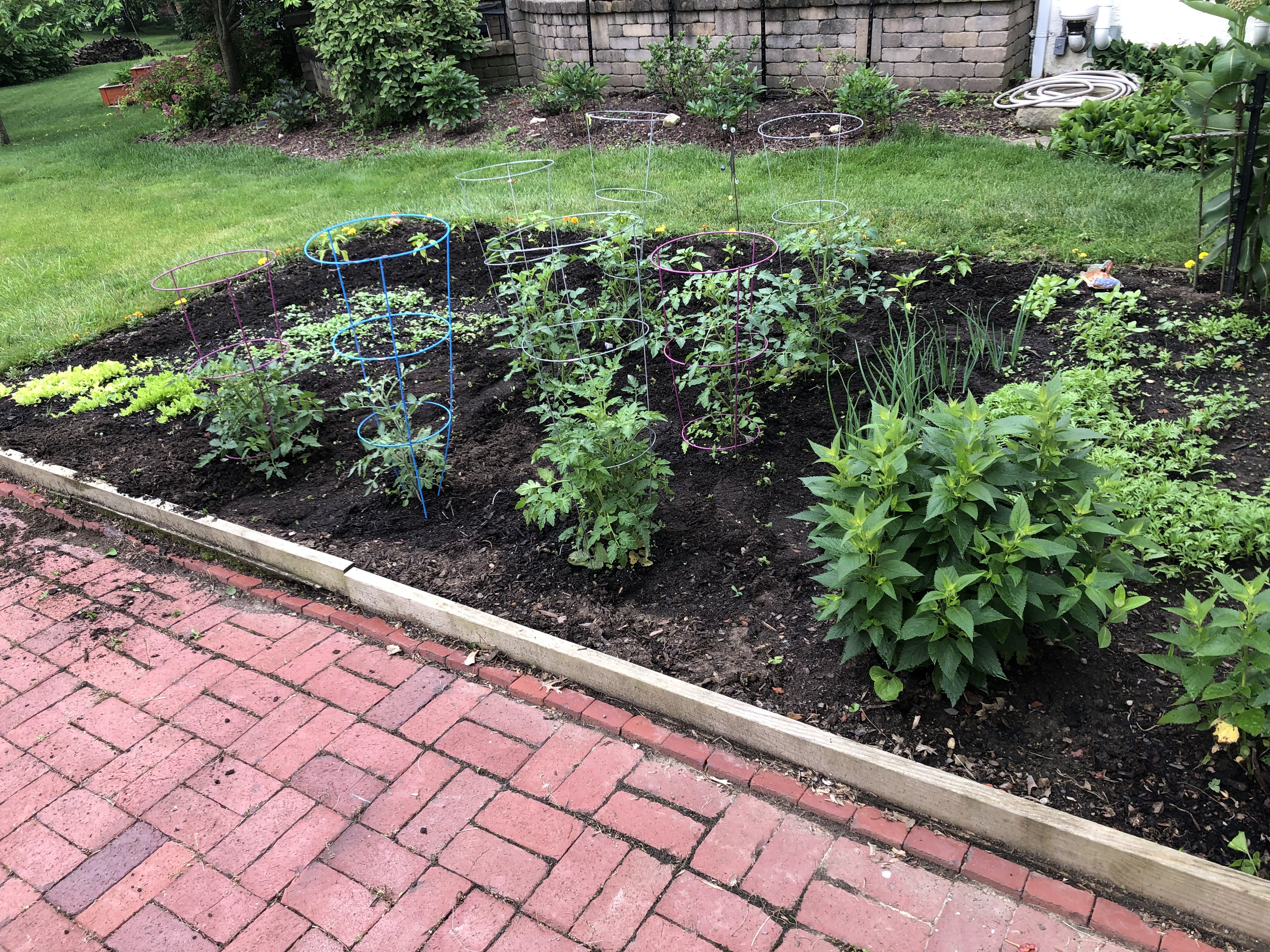
So here's where things stand at the end of the first week of June. The Hej garden is doing fine, especially the potatoes. I indeed called my aunt Gail about the potatoes and even sent her a picture of them, to her great delight. The photo arrived yesterday; Gail called me and we both laughed and laughed about the potatoes.

The Hej Garden


The kitchen garden is coming to life: the basil is finally stirring, the tomatoes are putting out blossoms (no tomatoes yet though). The peppers are holding back, demanding warmer weather. The back of that garden is a flower bed: sunflowers, cosmos (which I just broadcast each spring from the seeds gathered at the end of the prior summer), some zinnia and some wildflower seeds that I also just strewed about back a few weeks ago.


The kitchen garden 

And the same from the side

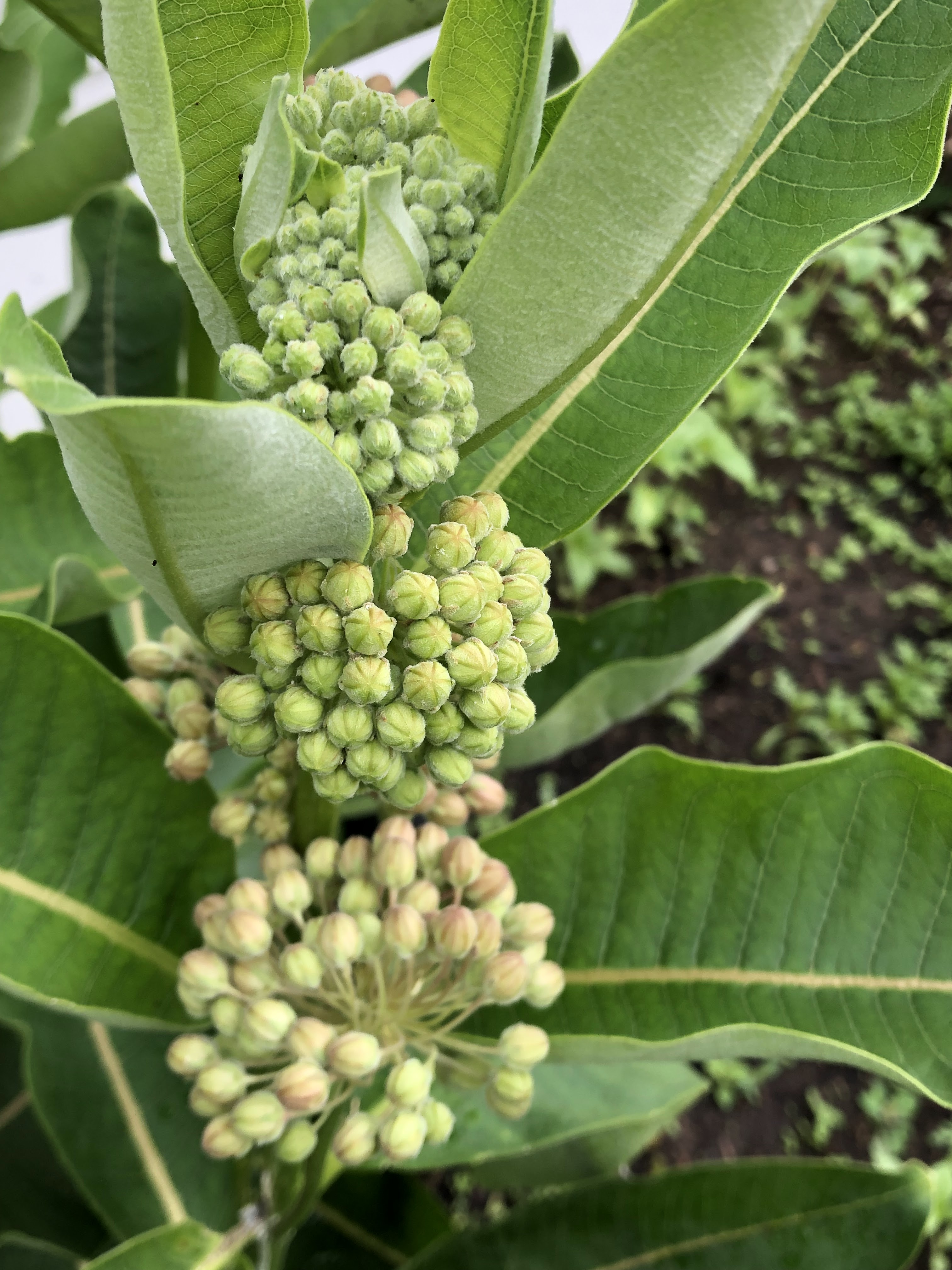
The kitchen garden is also where I have a small stand of milkweed; the blossoms are just starting to change towards their opening shades.

Milkweed blossoms forming

June has just started; we will see what it holds. I saw the first firefly two nights ago, we are starting to eat green onions from the red sets I picked up on markdown back several weeks ago. 

There is more to come in this year's gardens, from tomatoes to peaceful morning meditations. 

May I be open to it all. 

Tuesday, February 28, 2023

Past and Present


I was at a City Council meeting—our City Council—last night for the first time in years.

Years.

I went with Warren because Council was talking about a long-delayed reboot of its flag and banner policy. The Symphony has banners for Concert Week that have not been flown in months as the City has been slowly reviewing its policies in light of the Supreme Court ruling in Shurtleff v. Boston. (Note: Not much progress was made last night either.)

I had a small sense of Old Home Week when I walked into Council chambers. I used to serve on our Civil Service Commission, so there was a joke with our Police Chief (who'd been a captain back in those days) and I was able to congratulate our interim Fire Chief, someone I had gotten to know well from those years. (The firefighters union, to my delight, was ever-present at our meetings; our interim Chief was in that bunch back then.) The head of HR, also someone I had known forever, came in behind me, tapping me on the shoulder and leaning in to tell me she was glad to see me. And I sat right next to the young person who I will be voting for in the next Ward elections.

I do not know most of our Council members at all anymore, although I still know the City Manager and, of course, the City Planning Director. ("Of course" because I also sat on our Historic Preservation Commission for several years. Plus I was a zoning lawyer , so even thought the current planner and I did not overlap extensively in that era, I still worked with him and his department before I hung it up.)

I found myself thinking back, way way back, to myself as a college student, to the year I was in between schools, and all the hours I spent at council and school board meetings during that time.

When I withdrew from Chicago at the end of my freshman year, I retreated to Delaware,  moving in with my Aunt Ginger and my Grandma Skatzes. It was a long period of putting myself back together — in every way imaginable. I did not work those months. I volunteered at my high school, teaching classes with the greatest English teacher I ever had. And I started attending council and school board meetings.

I had met a newly elected council member on Election Night that fall, and he encouraged me to see what city government was all about. As I was thinking of staying in Delaware, I started thinking maybe I should get a better idea of how the school board operated as well.

It ended up being a fascinating time – I made friends I still have, I felt at home at council meetings (never school board, interestingly enough), and I began to learn how this city functioned. I knew the insider jokes and side comments at Council. I change my career goal to law school, realizing that, if I was going to stay in Delaware, as I was strongly thinking I would, I wanted to make a difference and have a say in how the community operated. I started to have plans to run for Council at the next election cycle.

That was in late 1975, early 1976. By that summer, I was back in Chicago, eventually on my way to living out west for several years. I did not return to Delaware permanently until the fall of 1990.

I did become a lawyer. And when I moved back, I ended up practicing in the office of that Council member. I had met so many years earlier.

I never ran for City Council. That was not a goal by 1990 and thereafter. I almost ran for school board, but had a conflict, so did not. My service on the two city commissions was enough.

I did not sit there last night full of  nostalgia or wondering "What if...?" Maybe I had a sense of relief that I had not ventured into politics. But maybe not even that. Maybe just a sense of being there, listening to Warren make his public comments, and then heading home.

And that was more than enough. 

Monday, July 13, 2020

One Finished, One Starting Soon


Somewhere back in the annals of this blog, I wrote about the fact that I collect quotes. I'm not scrolling back to find it (and my labels do not include the word "quotes") but I probably wrote about my love of writing down (or photocopying and taping in) quotes and excerpts that moved me at the time and important to keep over the years.

"Years" is an understatement. My current collection dates somewhere from the late 1980s, looking at what it contains. I did not start dating the collection until somewhere in the middle or end of the second volume, when I realized that an occasional chronological reference was useful. Even if I  take 1990 as the start point, I'm holding 30 years of quotes.

I had an earlier quote collection, one I started in the 1970s. It is long gone but I remember (vaguely) one quote in it was the beautiful observation by Christopher Milne (yes, that Christopher) about the original Pooh and friends being donated to the New York Public Library and having to explain that he had no attachment to those stuffed animals. The quote was something along the lines about he did not want them to be reminded "here was fame" and certainly didn't need them to be reminded that "there was love." 

My first book starts with this observation by Sarah Orne Jewett, a late 19th century Americn novelist, from her novel In The Country of the Pointed Firs (1896): "More than this one cannot give to a young state for its enlightment; the sea captains and the captains' wives of maine knew something of the world, and never mistook their native parishes for the whole instead of a part thereof..."

The book I finished filling last night ends with this quote from Love, Roddy Doyle's newest novel (and the first one I have ever read): 

—This place hasn't changed, he said.
He pointed at a line of old photographs.
—The dead writers are still dead, he said.

How could I not include that quote? 

Book 5 is waiting. I can hardly wait to see what it will hold. 


Sunday, June 21, 2020

A Look at the Gardens

Back in late April, I shared that our vegetable garden, the one I call the "kitchen garden," had been cleared and tilled by Warren, and was just waiting for planting. It looked like this then:


What I have not shared, because my posting has been, ahem, irregular at best, is that we added a second garden, the Hej (pronounced "hedge") garden. The Hej garden actually sits on our backyard neighbors' parcel. The owner before the current ones was an avid gardener, a certified Master Gardener, and she had established a thriving vegetable garden in the far back corner of the yard, just where it butts up to the little dogleg on Warren's parcel. It has been tilled but not planted for several seasons, as our current neighbors have many, many demands on their time and a garden just wasn't one of them. So I proposed that we take over the garden, they can have some of the vegetables grown on it (making me a sharecropper no matter how I look at it), and there we go. 

The Hej garden is our zucchini garden, because our kitchen garden does not have enough space for zucchini. It has been planted twice, because the first planting of 20 zucchini seeds resulted in five coming up.

Five.

You could toss a coin, call "heads," and get better results than that.

About three weeks ago, I tore out everything but those five zucchini and planted it over again, this time marking the seeds (which I doubled and tripled) with spoons:


And today, I was in the garden at 6:30 a.m., transplanting the zucchinis that came up in twos and threes to the spaces where there were still not results, marking the transplants and their former companions with the spoons upside down:


It's been a lot of work. This garden also contains  five extra tomato plants we had from my over-ordering tomatoes this year; they are along the fence on the left side of this photo. 

The kitchen garden and I likewise got off to a rocky start, but we have smoothed out our most of our differences. How rocky? Lettuce that didn't come up, parsley that didn't come up, marigolds (border) that didn't come up. You get the picture. So there was some extensive replanting in that garden as well. 

But just a day into summer, and it is looking good:


Bit by bit, it is coming along. Tomatoes are starting to form:


Indigo Rose


Early Girls


My very favorite feature is the ceramic partial border in the kitchen garden. As I continue to sort through stuff in my house, some of the stuff is headed west to my sons out there. Sam declined any of his childhood pottery attempts; Ben and Alise took a few. I couldn't just toss my children's offerings over the years, so I put them in the garden instead. 

The border


A ripply plant impression plant by Ben


A skull by Sam


I smile every time I walk by, seeing my children's art springing to life in the garden.


Wednesday, June 3, 2020

Observations About May Money


This pandemic and our grocery spending (because that is about the ONLY spending I am doing these days) continue to be...what? Fascinating? Mind boggling? Head scratching? All of these?

Yeah, all of these. 

After sailing through April with food expenditures well below the monthly $180.00 target I had set months ago, May costs went back up over that. May food costs were $218.52; household (non-food) expenditures were $23.43. The grand total? $242.36. 

That brings our monthly average year-to-date to $221.69.

And, once again, we did not eat out. Ohio has started reopening, and restaurants that can accommodate the mandatory distances are opening, but I have not yet been cleared by my oncologist to go beyond the boundaries of my home for all practical purposes. 

In preparing to write this post, especially in light of last month's revelations about my "twitch," I looked back at the three (yes, three) receipts for groceries in May. Some (a significant portion) of the expenditures consisted of stocking up on food items we routinely use such as coconut oil (my current jar is down to about a week's left), olive oil, and decaf instant coffee (I make chocolate mochas with it at home; I cannot drink caffeinated coffee). Those three items alone came to $14.77. Butter was on sale at Kroger and we spent $6.00 to get three pounds of unsalted as I was running low on it from the stocking up I did last December. (I use the unsalted in baking and there has been a lot of baking lately. A. Lot.) 

And let's talk about the steep rise in the cost of meat. Fortunately, we are not huge meat eaters. I cringe for family and friends who are. Around here, meat is more expensive and, of course, scarcer. So when I looked to order chicken thighs, the store's first response was it had none. By the time we picked up the order the next day, thighs were available, at a higher cost because these were boneless and skinless (the only type available).

So I get why the May expenses were higher. I also suspect that June will drop off precipitously as we eat our way through the items on hand. And maybe this will be the 2020 pattern: high, low, high, low. The good news going forward is that now that I am aware of my twitch, I am much more conscientious about what we order. Placing the second online order in May was stressful as I wrestled with making sure the items were needs and not twitches. (Once I placed the order, the stress dissolved.) When I am allowed back in a grocery, I hope to carry that awareness with me. 

On the gardening front, we are still weeks away from tomatoes. Many of the tomato plants are setting blooms and I am hoping that I will have one by month's end. Time will tell. The zucchini is not cooperating in germinating; I will be replanting that entire garden. (I now have a second garden, courtesy of our backyard neighbors, who have a great plot they never use. Basically, I am sharecropping zucchini this year.) Lettuce is coming along slowly; maybe in a few more weeks we will have lettuce. 

These were hard times before the Minneapolis killing tore even deeper fissures into our country. Our Legal Clinic, which is serving clients remotely, is already seeing its numbers rising and we know the tsunami of evictions and debt-related matters is on its way. I am dealing with personal issues as well, ranging from my health to accepting that I will not be able to travel to the Pacific Northwest this year. As the likelihood of the NW family contingent coming here is also nil, this will be first year since 2013 I have not seen Ramona and company in person. I get it, but it is still a disappointment. So the fact that I managed Tuesday to knock the entire stack of our everyday bowls off the shelf onto the counter and kitchen floor, shattering every last one, seemed somehow a fitting note.


Here's to a better June. 

Friday, May 1, 2020

Observations About April Money


When I wrote about our March food and household expenditures, I noted that we spent larger than normal amounts of money that month and the month before, most of it being related to stocking up on basics and staples. I also breathed the hope that our April spending would be much less.

Well, here it is May Day, although given our weather in Ohio, you'd swear we were in March still, and I have the numbers at hand because guess what? Our spending on food has decreased greatly so I only have a few numbers to add instead of a sheet full of them. And, looking at the decrease in spending, clearly we are looking at what we have around the house rather than jumping in the car to go to the grocery store to get something else (more about that later).

Our April food purchases? $144.56. Household items added up to $6.10, the bulk of that being trash liners for our household, a box which will last into 2021. Total? $150.66. That starts to yank the average YTD down from $238+ to $216+. I might get it down to $180.00/month average yet. We did not eat out (takeout) at all.

The food costs include two large shoppings at Aldi, one in person early in the month by Warren and one online for home delivery later in the month, one key food item when Warren had to get something for his shop at Walmart (What key food item? Kosher salt, a must have and something Aldi does not carry), and, finally, $5.00 to the Symphony for the Hershey's chocolate bars (from February's downtown Chocolate Walk) that I knew were there. The early Aldi shopping included two hams from Aldi at the pre-Easter price of 89¢ a pound. Those are now residing in the freezer and will come into play later on this year.

The most interesting revelation about April spending has been the changes I see in me. Even without the spending spurts in February and March, I now realize exactly what I mentioned above: I have a huge tendency to jump to the grocery store rather than ask myself "so what do we have here?"  Now that I am unable to go to the store and we are both very reluctant to have Warren in a store (because I am in such a high risk group), I find myself being far more thoughtful about food preparation. To borrow from blogger friend Laurie at The Clean Green Homestead, I am using what's on hand.

One item on hand now is sourdough starter, which I use weekly. (Well, I feed it weekly and then use the discard, but that's what sourdough starters are all about: feeding and discarding.) There are a variety of things you can bake with the discard, but my favorite to date has been sourdough brownies.

Sourdough starter (the bubbles show it is active)

But going back to realizing how much I just went to the grocery without thinking: this revelation about my twitchy impulse (to borrow from Anthony Ongaro, the one minimalist I enjoy, really like) caught me off guard. I famously do not shop. Ever. Malls? Nope. Online? Nope. Amazon Prime? Ha. I don't even buy books (very much) anymore. But apparently I was totally open to the call of the grocery store. And while it is likely another month or more before my oncologist lets me even stand near a grocery store, let alone set foot in one, this is a truth about me (that twitch to shop) that I need to be aware of when I finally do enter a grocery.

Despite my optimism in early April about gardening soon, the weather here has stayed colder than I expected for this time of year. We are still having occasional frosts. So there are no beds planted, other than the sprouted onions I planted for the first time ever, most of which seem to have settled in and are growing. I hope the gardening front is entirely different by May's end.

And until then, we'll enjoy the brownies.


Saturday, October 19, 2019

Some More Thoughts About The Essentials: Unplugging

My last post I  wrote about balancing the essential again the urgent or, really, about my tendency to shove the essential aside for the urgent. I have been thinking about that very concept for days now, trying to be more aware of my actions and activities.

As part of this, I have found within myself the commitment to finally tackle the paperwork clutter that I let pile up in my study. I'm not talking about a small stack on my desk. I am talking about a voluminous stack, which I then shift to the bed, which I then shift to a paper sack, telling myself "I'll get to that soon." And then don't.

For the past several days, I have been dealing with the piles (yes, plural) in 15 minute shifts. I set my alarm for 15, then tell myself to sort through and make three stacks: Keep (and file away at the end of the 15 minutes), Recycle, Shred. I am embarrassed to say the Shred pile has been large, the Recycle pile larger. The Keep pile? Small potatoes.

This morning I tackled the paper pile in two separate sessions (with enough interlude between the two that I did not feel overwhelmed by the task before me). While doing so, I came across some notes, meant to be a blog post, from just after we got back from vacation. Here they are, as they perhaps tell a story related to the essential:

Unplugging

 When we went on vacation, I left behind my Chromebook because it pushed the limits of my minimal packing too far.

12 days without email or Facebook. That was interesting.

And eye opening.

Two things I learned:

  1. Despite my protestations to the contrary (and reading books as much as I do), my mindless perusal of social media has steadily increased over time, especially on weekends.
  2. Along with that increase, my time to do other things decreases.What other things? Write letters, read, prep zucchini and apples for freezing [remember, this was written in early September], or just sit and luxuriate in the moment.

So now I am looking at all my electronic tethering: the computer, the Chromebook, the phone. I carry a flip phone, not a smart phone, so the temptations are fewer, but there is still texting. And based on that and my vacation experience, I am ready to take a few more steps:

  1. I am already not on my computer/Chromebook most evenings after 6:00 (and often earlier). What if I eliminated Saturday and Sunday too? Or only use Word and Numbers for work-related or Clinic purposes? Or only turn it on an hour one of those days for those reasons and also to blog? 
  2. When I am at work, I carry my phone. I always have it on me or nearby at home. I always carry it in my car if I am running errands or driving to a school; with a 14+ year old car, I want a way to call someone if I get stranded. But what if I stopped carrying it at all when we (Warren and I) go out? There is no news, good or bad, that the delay in seeing the message would make a difference. 

I am penning these thoughts sitting at a rehearsal an hour away from home. I left my phone at home. I'm not sure of the time because I am not wearing a wristwatch and to wear one again would require a new battery. But with the phone gone, I am also not glancing constantly to see what the time is or whether anyone has texted me or tried to call.

So what if I tried this? What if I tried stepping away even more?

I know there will be exceptions from time to time. We should be reestablishing weekly chats with Ramona soon and those will fall in the early evening because of the time difference between here and there. There will an occasion, most likely related to my writing the Symphony press releases, which will find me on the computer some evening.

It is hard to break the lines of the electronic. One of my favorite minimalists is Anthony Ongaro at Break The Twitch. He came up with that name to describe the mindless clicking of the mouse to make yet another unnecessary purchase, but it fits here as well. My twitch is not to buy, but to click mindlessly across sites.

So what do I hope to get out of breaking my own twitch? I hope to be more mindful. I hope to be more thoughtful. I hope to deepen my personal connections to my work, to my day, to my marriage, to my friends.

To my community.

I hope to be more connected to my self.

*******
That's where my notes ended. They were written about a month ago. In the time since, I have managed to turn off or not even start the computer most (all?) evenings and even some weekend days (this is not one of them, obviously, but it IS going off soon). I have found it even easier to turn down the phone and only check for messages/calls occasionally.

And this goes back to thoughts of the essential. It is essential for me to connect outside of the electronic world. It is essential for me to reclaim that time.

Let's see where this goes.

Saturday, October 12, 2019

The Essential And The Urgent

I spoke last week to a local United Methodist Women's group, an engagement that had been scheduled in late 2018 and, through a series of calendar complications, mostly of my own making, got moved more than once. It had been scheduled long enough that, in preparation for my talk, I scanned the most recent church newsletter to see if there was any note about the evening.

There was not. But in the minister's message, which I just happened to glance at, I found such a nugget that I have been walking around quoting it (usually badly paraphrasing it) ever since.

The minister had taken time away from the pulpit in August. In the September newsletter, he reflected on what he had learned during his renewal leave. His second observation caused me to stop reading:

It's easy for the essential to be crowded out by the urgent. 

I read that again, then said it out loud.

It's easy for the essential to be crowded out by the urgent. 

Holy moly. If that isn't my life, then I don't know what is. When I look back on my posts, my conversations with colleagues and friends and my dear husband, my letters, my thoughts (day or night, a day just starting or a day half over, or a day spent and gone), an overwhelming portion of my thoughts and sentences are spent on the urgent (or what I perceive to be "urgent") and on complaining (internally or externally) about how I never have enough time to get to the essential. My writing comes to mind immediately. Even when I have in mind a brief post or have sketched out some thoughts for one (or for my column or for a poem), I too easily shelve it in the urgency of the moment. ("How can I take time to write now? There's [name it] that needs done.")

And when I talk about the "urgent," I am not referring to the daily routine. Yes, the laundry needs done. Yes, the meal needs prepared. Tasks are tasks. I am talking about the white noise: the everything else that I frantically grab at and tend to all the time. All. The. Time.

So this sentence grabbed me and shook me.

It's easy for the essential to be crowded out by the urgent. 

It is still shaking me. April, it shouts, what are you doing? You are throwing away the essential to do the urgent.  STOP IT.

As I noted, I read that sentence last week. I have been handing it out like business cards ever since. I met a new friend for coffee in one of our local shops this Thursday past. Standing at the counter, I chatted with the proprietor about how her week was going. She made the typical comment about how busy things were, how hectic things were. I started to agree, then remembered my sentence and pulled it out, clumsily paraphrasing it.

Shelley stopped immediately. "Oh, I like that! How true!"

How true, indeed.

I do a poor job of not letting the urgent crowd out the essential. I know that about myself. That is why my study is a mess, why my writing is in piles here and there (some literal piles, some figurative piles), why I always seem to be busy. Coming off of the High Holy Days, during which I indeed let the urgent (the tasks and demands of the day) crowd out the essential (the spiritual significance and self-reflection required), I am telling myself that, in this year that has just started, I need to make an effort to live more essentially and less urgently.

Need to make? Have to make.

It's easy for the essential to be crowded out by the urgent. 

Let's see where this takes me.

Sunday, September 29, 2019

Starting To Wind Down The Garden


 This was a hard week, ending a hard month. This week was a particularly hard ending to September as we did a 54-hour door-to-door road trip to Mayo, sliced and diced so thin because of other equally (more?) pressing matters at home, including the Symphony. Oh, we made the trip all right, but I got spectacularly road-sick once we were back home, vomiting with such force that I ended up with a severely swollen face and a black eye.

I'm much better now.

It is the last Sunday in September and the eve of Rosh Hashanah, for which I am not spiritually ready in the least, and it is an intense spiritual holiday, opening the High Holy Days. So perhaps it was not all bad that I just came in from an hour in the garden, cleaning it up somewhat, checking what was going on (peppers now going strong, tomatoes on the wane) and, perhaps, showing some optimism myself in one of the garden tasks I accomplished.

The bees in the agastache 
The bees are still around and I caught a few in the agastache. They were far heavier in number earlier in the summer, usually so many that you could hear the plants hum. As Warren and I looked the bed over (cutting back on agastache bunch that had uprooted in the drought), I looked up at the tall ornamental grasses we had transplanted from a friend's giveaways. 

"Look."

The grasses have gone to seed and are beautiful in a new and different way.

The ornamental grass going to seed 

I picked tomatoes this morning, while Warren deadheaded the marigolds rimming two of the four sides of the garden. This late in the season, the marigolds in are full glory, blazing away, paying no heed to the coming autumn, seemingly impervious to the coming frosts and snows. As for the tomatoes, after I picked (and trimmed back and even pulled out one plant, done for the year), I ended up with a respectable load to share with my family's joint household here in town.


The basil got caught in the heat while we were out in Oregon and Washington, and never recovered. I'm glad I made pesto earlier in the season. I contemplated pulling it up, then figured that task could wait. 

We are clearly moving into the cooler days, with the sun moving along its fall course. With the cooler weather comes the hope of a fall crop of lettuce. So I spent a quiet half hour or so breaking up the dried soil in the planters, remixing the soil, and seeding it again. I'm going with the Black Seeded Simpson and Emerald Jewel for the fall, having found those the most enjoyable of the ones I tried this spring.

And maybe that's my optimism: seeding four planters in lettuce seed, hoping for a fall crop of salad, looking forward to what the autumn holds. 

One of four planters, seeded for salad

And perhaps my thoughts while I prepared the planters was some preparation for the High Holy Days.

The High Holy Days are a time of contemplation and self-assessment. It is a time for soul-searching. What did I accomplish last year? What were my biggest mistakes? What do I want to change for the coming year? What do I need to change in myself?

Mixing the soil, breaking up the clods, adding some plant food, watering it to the right consistency were all concrete tasks with fixed end points. My mind could wander through some of those more intense, personal thoughts: Where am I in my life? What does this year hold? Who am I now?

The Jewish sage Maimonides came to mind: "If I am not for myself, who will be for me? If I am for myself only, then what am I? And if not now, when?"

And if not now, when?

Let me see what the New Year brings, both inside me and outside in the garden. 

Sunday, July 28, 2019

Coming Full Circle

In this part of Ohio (smack dead center) when I was growing up (I started 1st grade in 1962), it was not unusual to hear a classmate announce "I'm part Indian" or "I'm part Cherokee" or something similar. (Maybe it still is, but I am talking about then, not now.) Everyone (well, at least four or five kids)  claimed Native American ancestry, often Cherokee, whenever indigenous peoples were talked about, which in school meant when we talked about "ancient" Ohio history—the Adena and Hopewell tribes, called "Mound Builders" by the dominant white colonial society—or around Thanksgiving.

Heck, my family even had an "We're part Indian" story that persisted into the 21st century. My
Grandma Skatzes: not Native American 
Grandmother Skatzes told stories, perhaps more than one, that we had a Native American ancestor in her family tree. It was a grandmother, three or four generations back, who would tie her children to the fence so that she could work in the garden. (My grandmother, a gentle-hearted soul, would tear up when she told this, saying "That was a cruel and terrible thing to do! Those little children would holler all day long!") There was never a name attached to this allegedly Native American ancestor, just the story of tying the children up so she could do her chores.

Another version which popped up once or twice was that we had a male ancestor, supposedly of the Apache tribe, somewhere back in the past. Seriously? Besides the fact that the historical lands of the Apache were in the southwestern part of this country, a part of the country we did not move to or come from, a narrative involving a relationship with a male Native American runs contrary to what the standard settler/Native interrelationships looked like: male settler, Native woman.

Trust me, it didn't happen.

Still, the stories persisted. As I grew older and learned more history of the colonization in this part of the country, I began to disbelieve the whole family myth of a Native American ancestor. Most of our maternal genealogical records, even without digging too deep, followed such traditional white trajectories that I could not begin to shoehorn a Native American ancestor into them. Rape or sexual assault somewhere in the past? Absolutely a possibility. But a marriage or domestic partnership? No way. It was white, white, white all the way.

With the advent of DNA testing for "heritage" purposes, one of my cousins on my maternal side took a test. She was excited waiting for the results, anticipating seeing threads of that Native American ancestor pop up in the results. I told her to be prepared: there won't be any Native American DNA identified. Yes, there will be, April! Just wait and see!

True to my prediction, there was no Native American DNA. Zero, nada, nothing. Unlike Elizabeth Warren, we couldn't even pretend to have any Native American lineage.

That story resurfaced when I went to Kentucky last month with my dad and brother and sister-in-law. While we were eating dinner at a Bob Evans, Mark brought up that we have Native American blood in the Strickler family line (our mom's maternal lineage).

"No, we don't. There might be some in the family, but it's not there."

Dad looked at me quizzically. "The Skatzes side?" (That would be Mom's paternal lineage.)

"Not there either," I said, explaining that our cousin (who has the same Skatzes/Strickler DNA that my brother and I do) had a DNA test and the results were negative for Native American DNA.

"Frankly, if there is any Native American blood, it'll be on your side, Dad."

I went on to point our that his family history, of which I know the bare bones narrative, was more likely to have Native American/settler interrelationships of the kind that would lead to marriage or a domestic partnership. Our ancestors were in Virginia, Tennessee, and Kentucky very early in the dominant white colonial history of this country, and probably far enough in advance of "civilization" that tribes in the area would have been the only other humans around.

That's when I came to a complete stop in my mind.

Oh hell.

We, my family, did that. We were part of that wave of white settlers invaders, part of the white colonization mindset that it all belonged to us and those others—those indigenous people seen as lesser than, if seen as human at all—deserved to be pushed out of the way or slaughtered or both in the name of God, the King, the United States, the whatever.

We were those people and for all of my participation in circles on historical trauma and cultural and biological genocide and (gulp) restorative justice, it never hit me that I was a direct heir and beneficiary of that. All my law school clerk experience in the Native American law field, my championing of tribal law and the many Native sovereign nations: that was good work, but I was flying blind, in the fog, and upside down. I couldn't even coast by saying my family came to those parts of the United States (Virginia, Tennessee, Kentucky, Ohio) post-Civil War through Ellis Island after all the tribes had been exterminated or removed.

Oh, no, no, no, we were here from the very beginning and took part of that long, horrific history.

Oh hell. Talk about privilege. Talk about white dominant colonial culture bias.

Talk about feeling like a totally clueless goof.

If my child-in-law Alise, who is Anishinaabe, is reading this post, this is about the point where she is nodding her head and saying "uh huh, April, uh huh. Now you get it."

Better late than never.

But dang, that "late" was way late in coming.

Wednesday, June 12, 2019

A Decade Out And What's Next?

The blogger at Plough Monday, to which I subscribe, recently announced he was closing the blog. His notice was short and went right to the point:

Hello all. I am closing my blog, Plough Monday. I am doing so because I want to redirect my writing efforts towards publishing in literary journals and magazines.  And I have found that my writing here works to undercut this redirection.
My blog will be visible for a short while, and then it will close.
Thanks for reading.
I told Warren that the news gave me pause. The evening before the Plough Monday announcement, I was looking back at my older posts and I realized I have been blogging for over a decade. My first post was in March, 2009.

A decade.

That's a lot of words. That's a lot of posts, this being the 723rd.

And what about my writing? My other writing?

What does that even mean: my other writing?

There is the middle school novel, now about three-quarters done. I recently returned to it for the first time since—wait for it—September 2017.

Yeah, September 2017. But who's counting?

There is the poetry, with my averaging about three submissions a year for the last three years. I am garnering exactly one acceptance a year, the latest being in the Licking River Review.  (I don't know when publication will be.) If I were in the major leagues, that would give me a batting average of .333, which is nothing to sneeze at, but I'm not so sure those same stats hold true in the publication world.

If I spent more time writing poetry and sending it out, would I get more acceptances?

There is my almost monthly column for The Myeloma Beacon. I began writing that in early 2013, over six years ago.

The truth is I wasn't expecting that I would live long enough to see five years of columns, let along be well into my seventh year.

Do I hit reset? Do I redirect my efforts?

I'd like to finish that novel. (I have drafts of other novels, aimed for the adult reader, but this one is near and dear to my heart.)

I'd like to write more poetry. (I came home from Nashville with a poem roughed out, which I tore out of the notebook and stuck in the pile of other poems I have roughed out but not returned to in too many weeks and months.)

I'd like to figure out how to write more. But I also know myself well enough to know I hold other values dear into which I put my time and energy. My marriage. Family. Friends. This community. Reading. Our Symphony. My work at Court. Pies. My garden.

So for now, I am just thinking about the Plough Monday announcement, just thinking about my writing, and just thinking about...what's next.

Tuesday, January 8, 2019

Small Moment

A morning view from our deck, but not at THIS time of year! 

I have started off 2019 trying to alter my daily routine in small ways. As I have noted before, I don't make resolutions. But much like I feel during the High Holy Days, I see the changing of the calendar year as a time of reflection and self-examination.

One of the very small things I have been doing is stepping outside on our back deck, often before the sun rises, for a moment or two each morning (the moment is very short if it is raining). I stand there  in quiet appreciation that I am still here to see this day.

Line 24 of Psalm 118 comes to me as I stand there: This is the day the Lord has made. Let us rejoice and be glad in it.

I will rejoice indeed.